=* A Distributed Proofreaders Canada eBook *=
This ebook is made available at no cost and with very few restrictions.
These restrictions apply only if (1) you make a change in the ebook
(other than alteration for different display devices), or (2) you are
making commercial use of the ebook. If either of these conditions
applies, please contact a FP administrator before proceeding.
This work is in the Canadian public domain, but may be under copyright
in some countries. If you live outside Canada, check your country’s
copyright laws. IF THE BOOK IS UNDER COPYRIGHT IN YOUR COUNTRY, DO NOT
DOWNLOAD OR REDISTRIBUTE THIS FILE.
_Title:_ The Edwardians
_Date of first publication:_ 1930
_Author:_ V. Sackville-West (1892-1962)
_Date first posted:_ Nov. 17, 2018
_Date last updated:_ Nov. 17, 2018
Faded Page eBook #20181125
This ebook was produced by: Al Haines, Jen Haines & the online
Distributed Proofreaders Canada team at http://www.pgdpcanada.net
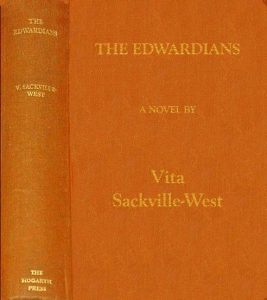
[Cover Illustration]
By V. Sackville-West
_Fiction_
SEDUCERS IN ECUADOR
_Travel_
PASSENGER TO TEHERAN
TWELVE DAYS
_Poetry_
KING’S DAUGHTER
THE LAND
_Published by_ Wm. Heinemann, Ltd.
THE
EDWARDIANS
V. SACKVILLE-WEST
[Illustration: Wolfhead Logo of Hogarth Press]
THIRD IMPRESSION
PUBLISHED BY LEONARD & VIRGINIA WOOLF
THE HOGARTH PRESS, TAVISTOCK SQUARE
1930
_First Published May 1930_
_Second Impression June 1930_
_Third Impression October 1930_
_Printed in Great Britain by_ R. & R. Clark, Limited, _Edinburgh_.
A U T H O R ’ S N O T E
No character in this book is wholly fictitious
CONTENTS
PAGE
I. Chevron 9
II. Anquetil 49
III. Sylvia 96
IV. Sylvia 152
V. Teresa 197
VI. Teresa 249
VII. Anquetil 305
I
CHEVRON
Among the many problems which beset the novelist, not the least weighty
is the choice of the moment at which to begin his novel. It is
necessary, it is indeed unavoidable, that he should intersect the lives
of his dramatis personae at a given hour; all that remains is to decide
which hour it shall be, and in what situation they shall be discovered.
There is no more reason why they should not first be observed lying in a
bassinette—having just been deposited for the first time in it—than
that the reader should make their acquaintance in despairing middle age,
having just been pulled out of a canal. Life, considered in this manner
from the novelist’s point of view, is a long stretch full of variety, in
which every hour and circumstance have their peculiar merit, and might
furnish a suitable spring-board for the beginning of a story. Life,
moreover, as we continue to consider it from the novelist’s point of
view, life although varied is seen to be continuous; there is only one
beginning and only one ending, no intermediate beginnings and endings
such as the poor novelist must arbitrarily impose; which perhaps
explains why so many novels, shirking the disagreeable reminder of
Death, end with Marriage, as the only admissible and effective crack in
continuity. So much for the end; but there are obvious disadvantages to
starting the hero off with his birth. For one thing, he is already
surrounded by grown-ups, who by reason of his tender and inarticulate
age must play some part in the novel, or at any rate in the first
chapters of it, and whose lives are already complicated in such a
fashion that it is no true beginning for them when they are hauled
ready-made into the story. For another thing—but I need not enlarge.
The arbitrariness of choice has already been made sufficiently evident,
and no further justification is necessary to explain why we irrupt into
the life of our hero (for so, I suppose, he must be called) at the age
of nineteen, and meet him upon the roof a little after midday on Sunday,
July the 23rd, nineteen hundred and five.
* * * * *
He had climbed on to the roof not only because for years such exercise
had been his favourite pastime but because it was now his only certain
method of escape. Escape was a necessity; otherwise, his mother expected
him to play the host, which meant that the men chaffed him and that the
women rumpled his hair. Even at that early age, he liked his hair to be
oiled and tidy. Even at that early age, he resented any intrusion,
however genial, upon his privacy. So he escaped; sprang upstairs through
the rich confusion of staircases and rooms; and finally reaching the
attics pushed his way out through a small door which opened on to the
leads. Nimble in tennis-shoes, he went up an angle of the sloping tiles,
to sit astride the peak of the roof; tore his shirt open, fanned his
flushed face, and drank the air in large draughts. Arrived there, his
surroundings supported him in the most approved fashion. A cloud of
white pigeons wheeled above him in the blue sky. Acres of red-brown roof
surrounded him, heraldic beasts carved in stone sitting at each corner
of the gables. Across the great courtyard the flag floated red and blue
and languid from a tower. Down in the garden, on a lawn of brilliant
green, he could see the sprinkled figures of his mother’s guests, some
sitting under the trees, some strolling about; he could hear their
laughter and the tap of the croquet mallets. Round the garden spread the
park; a herd of deer stood flicking with their short tails in the shade
of the beeches. All this he could see from the free height of the roof.
Immediately below him—very far below, it seemed—lay a small inner
court, paved, with an immense bay-tree growing against the grey wall,
and as he peered down, feeling a little giddy, he saw a procession
emerge from a door and take its way across to a door opposite. He
grinned. Well did he know what this procession meant. It meant that at a
given moment in the servants’ dinner, the flock of housemaids had risen
from their seats in the servants’ hall, and, carrying their plates of
pudding in their hands, were retiring to their own sitting-room to
complete their meal. So the procession came, one, two, three, four,
five, six, seven, eight, one behind the other, in print dresses and
white aprons, carrying their plates, each plate with a dab of pudding on
it and a spoon laid across, as though they observed the ritual of some
ancient and hierarchical etiquette.




Reader notes
Loading reader notes…