=* A Distributed Proofreaders Canada eBook *=
This ebook is made available at no cost and with very few restrictions.
These restrictions apply only if (1) you make a change in the ebook
(other than alteration for different display devices), or (2) you are
making commercial use of the ebook. If either of these conditions
applies, please contact a FP administrator before proceeding.
This work is in the Canadian public domain, but may be under copyright
in some countries. If you live outside Canada, check your country’s
copyright laws. IF THE BOOK IS UNDER COPYRIGHT IN YOUR COUNTRY, DO NOT
DOWNLOAD OR REDISTRIBUTE THIS FILE.
_Title:_ The Minister’s Daughter
_Date of first publication:_ 1903
_Author:_ L. M. (Lucy Maud) Montgomery (1874-1942)
_Date first posted:_ May 5, 2017
_Date last updated:_ May 5, 2017
Faded Page eBook #20170508
This ebook was produced by: Alex White & the online Distributed
Proofreaders Canada team at http://www.pgdpcanada.net
The Minister’s Daughter
L. M. Montgomery
Illustrated by Henry E. Vallely
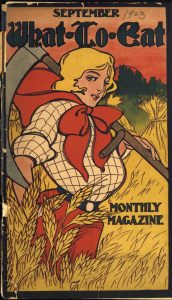
First published in _What to Eat_, September 1903.
[Illustration]
Walter Armstrong found himself belated at twilight near the little
Westlands church. He had missed his way and did not know the road back
to the hotel. There was a light in the church and a few horses were tied
to the fence. He stood his wheel up against the building and went in.
It was a young people’s meeting. About a score of young men and women
were assembled in the center pews of the badly lighted room. Armstrong’s
entrance caused a little stir. Some looked around at him wonderingly.
The leader of the meeting, a young girl with a sweet, frightened face,
grew palpably nervous and made several mistakes in the verses she was
reading.
[Illustration: She went where the organ stood.]
Armstrong dropped into a seat back among the shadows. The people present
were all strangers to him, with the exception of a young man who
supplied the summer hotel at the beach with “garden truck,” whom
Armstrong knew by sight.
Three seats ahead of him, with her head bowed devotedly on the hard rim
of the pew before her, was a young girl in a white dress. She had
magnificent hair of a warm chestnut with a glistening ripple in it.
Armstrong, who had a decided weakness for chestnut hair, began to wonder
if her face were pretty enough to match it. He was afraid to see it lest
it should not be. While the aforesaid young man led in prayer Armstrong
mentally fashioned out the face she ought to have if Nature had been
true to the eternal fitness of things.
“Very dark blue eyes—straight nose—fairly large mouth—creamy skin
with color coming and going faintly—that is how it ought to be but
won’t. I’ve been tricked before like that. She’s fatally sure to have
sharp cheek bones and a muddy complexion. Wish she’d turn around.”
She did not turn around, but when the prayer was over she rose and went
up the aisle to the dim little corner where the organ stood. As she sat
the lamplight fell over her face and Armstrong started. After all, it
did match; it was the very face he had pictured—only it was the face of
a saint whereas Armstrong, being of the world, worldly, had given it a
different expression.
He watched her as she sang. He had seen a great many beautiful women,
but never one so lovely as this girl. When the hymn was ended he had
forgotten all about the road back to his hotel; he was wondering how he
could get an introduction to her.
When the meeting was over he found that some were going to stay for
choir practice. He went up the aisle to the man he knew—Ross Nelson by
name—and asked him the nearest way back to the hotel. He was looking at
the girl at the organ all the time and did not hear a word of Nelson’s
reply.
“Who is that girl?” he asked, with a nod of his head in her direction.
“That? Why, she’s Miss Hastings, our minister’s daughter,” said Nelson
in a surprised tone, as if he thought everybody ought to know her.
“Introduce me, will you?” said Armstrong, coolly, and Nelson towed him
doubtfully over. The ceremony of introduction was performed in an
awkward, stilted style, and Armstrong bowed gravely.
Sylvia Hastings blushed. The warm inroads of color over her soft, round
cheeks were very becoming and Armstrong always declared he lost his
heart to her that very instant. But he had to subside into the
background almost immediately for the choir practice began and lasted
for an hour. He waited doggedly through it and when it was over asked
Miss Hastings if he might walk home with her. Sylvia was too shy to
refuse, even if she had wished. She had never had such a request before.
Nelson, who had paired off with the meeting leader, and the other
couples looked curiously after them as they crossed the moonlight space.
It seemed to them nothing short of sacrilege that a young man in a
bicycle suit should walk home with the minister’s daughter.
Armstrong had no idea how far it was to the Westlands manse, but he
hoped it was miles. As a matter of fact, it was a good long walk. Sylvia
could hardly be induced to talk at all, at first; when she did it was
about the prayer meeting, and she asked him timidly if he were
interested in the Christian Endeavor movement. He shamelessly avowed
that he was, and floundered helplessly through the deep waters of a
discussion upon methods of work into which she inveigled him. He
betrayed his ignorance speedily, and Sylvia’s eyes gleamed with mischief
in the moonlight. Armstrong began to suspect that she was having a
little innocent fun at his expense and he wisely refused to discuss the
subject further.
When they reached the manse he reluctantly surrendered her hymn book and
asked if he might call.
Sylvia blushed again and hesitated. She knew very little about young
men. Almost the only ones she had ever met, barring the Westlands lads,
were the pale-faced, abstracted “supplies” who occasionally preached for
her father and visited the manse. They talked to her, when they noticed
her at all, about missions and Christian Endeavor movements and other
church matters. This young man was very different; she had found him
delightful, but she was afraid her father would not approve of him.
There was about him a distinct atmosphere of Vanity Fair of which the
good Westlands minister had a holy horror. Sylvia did not know what
answer to make.
“I would like to see you,” she said at last, “but—I am not sure that
father and mother would. They—they—I don’t think they like anybody but
ministers.”
Armstrong laughed.
“I’m sorry that I’m not a minister, then, and I’m afraid I couldn’t
successfully disguise myself as one. But after all it is your opinion
that chiefly matters—to me. Do you restrict your circle of friendship
to ministers?”




Reader notes
Loading reader notes…