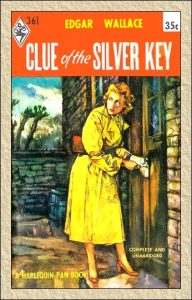
* A Distributed Proofreaders Canada eBook *
This eBook is made available at no cost and with very few
restrictions. These restrictions apply only if (1) you make
a change in the eBook (other than alteration for different
display devices), or (2) you are making commercial use of
the eBook. If either of these conditions applies, please
contact an FP administrator before proceeding.
This work is in the Canadian public domain, but may be under
copyright in some countries. If you live outside Canada, check your
country’s copyright laws. IF THE BOOK IS UNDER COPYRIGHT
IN YOUR COUNTRY, DO NOT DOWNLOAD OR REDISTRIBUTE THIS FILE.
Title: The Clue of the Silver Key
Date of first publication: 1930
Author: Edgar Wallace (1875-1932)
Date first posted: July 10, 2013
Date last updated: July 10, 2013
Faded Page eBook #20130713
This eBook was produced by: David T. Jones, Mary Meehan, Al Haines
& the online Distributed Proofreaders Canada team at http://www.pgdpcanada.net
THE CLUE OF THE SILVER KEY
_by_ EDGAR WALLACE
H&S
HODDER AND STOUGHTON
LIMITED LONDON
_Dedicated
to_
MICHAEL BEARY
MADE AND PRINTED IN GREAT BRITAIN FOR HODDER AND STOUGHTON, LTD.,
BY BILLING AND SONS LTD., GUILDFORD AND ESHER.
CHAPTER ONE
They were all in this business–Dick Allenby, inventor and heir-at-law;
Jerry Dornford, man about town and wastrel; Mike Hennessey, theatrical
adventurer; Mary Lane, small part actress; Leo Moran, banker and
speculator; Horace Tom Tickler (alas, for him!) was very much in it,
though he knew nothing about it.
Mr. Washington Wirth, who gave parties and loved flattery; old Hervey
Lyne and the patient Binny, who pulled his bath-chair and made his
breakfast and wrote his letters–and Surefoot Smith.
There came a day when Binny, who was an assiduous reader of newspapers
that dealt with the more picturesque aspects of crime, was to find
himself the focal point of attention and his evidence read by millions
who had never before heard of him–a wonderful experience.
Mr. Washington Wirth’s parties were most exclusive affairs and, in a
sense, select. The guests were chosen with care, and might not, in the
manner of the age, invite the uninvited to accompany them; but they
were, as Mary Lane said, “an odd lot.” She went because Mike Hennessey
asked her, and she rather liked the stout and lethargic Mike. People
called him “poor old Mike” because of his bankruptcies, but just now
sympathy would be wasted on him. He had found Mr. Washington Wirth, a
patron of the theatre and things theatrical, and Mr. Washington Wirth
was a very rich man.
He was also a mysterious man. He was generally believed to live in the
Midlands and to be associated with industry. His London address was the
Kellner Hotel, but he never slept there. His secretary would telephone
in advance for the Imperial suite on a certain day, and on the evening
of that day, when supper was laid for his twenty or thirty guests, and
the specially hired orchestra was tuning up, he would appear, a stout,
flaxen-haired man in horn-rimmed spectacles. The uncharitable said his
flaxen hair was a wig, which may or may not have been true.
He was perfectly tailored, invariably wore white kid gloves. He spoke in
a high, falsetto voice, had a trick of clicking his heels and kissing
the hands of his lady guests which was very Continental.
His guests were hand-picked. He chose–or Mike chose for him–the
smaller theatrical fry; chorus girls, small part ladies, an obscure
singer or two.
Once Mike had suggested a brighter kind of party. Mr. Wirth was shocked.
“I want nothing fast,” he said.
He loved adulation–and had his fill of it. He was a generous spender,
a giver of expensive presents; people living on the verge of poverty
might be excused a little flattering.
You could not gate-crash into one of Mr. Washington Wirth’s parties,
invitations to which came in the shape of a small oblong badge, not
unlike the badge worn by the ladies in the Royal Enclosure at Ascot, on
which the name of the invited guest was written. This the recipient
wore; it served a double purpose, for it enabled Mr. Wirth to read and
address each of his guests by her name.
Mary Lane was well aware that the invitation was no tribute to her own
eminence.
“I suppose if I had been a really important guest I shouldn’t have been
invited?” she said.
Mike smiled good-naturedly.
“You _are_ important, Mary–the most important person here, my dear. The
old boy was keen to know you.”
“Who is he?”
Mike shook his head.
“He’s got all the money in the world,” he said.
She laughed. Mary Lane was very lovely when she laughed. She was
conscious that Washington Wirth, albeit occupied with the cooing
attention of two blonde lovelies, was watching her out of the side of
his eyes.
“He gives lots of parties, doesn’t he?” she asked. “Mr. Allenby told me
today that they are monthly affairs. He must be rich, of course, or he
wouldn’t keep our play running. Honestly, Mike, we must be losing a
fortune at the Sheridan.”
Mike Hennessey took his cigar from his mouth and looked at the ash.
“I’m not losing a fortune,” he said. Then, most unexpectedly: “Old
Hervey Lyne a friend of yours, Mary?”
She denied the friendship with some vigour.
“No, he’s my guardian. Why?”
Mike put back his cigar deliberately.
The band had struck up a waltz. Mr. Wirth was gyrating awkwardly,
holding at arm’s length a lady from the Jollity who was used to being
held more tightly.
“I had an idea you were connected,” he said. “Moneylender, wasn’t he?
That’s how he made his stuff. Is Mr. Allenby related to him?”
There was a certain significance in the question, and she flushed.
“Yes–his nephew.” She was a little disconcerted. “Why?”
Mike looked past her at the dancers.
“Trying to pretend they enjoy it,” he said. “They’re all getting
gold-mounted vanity bags tonight–you’ll get yours.”
“But why do you ask about Mr. Lyne?” she persisted.
“Just wondering how well you knew the old man. No, he’s never lent me
money. He wants gilt-edged security and I’ve never had it. Moran’s his
banker.”
Mike was one of those disconcerting men whose speech followed the
eccentric course of their thoughts.
He chuckled.
“Funny, that, Mary. Moran’s his banker. You don’t see the joke, but I
do.”
She knew Leo Moran slightly. He was by way of being a friend of Dick
Allenby’s, and he was, she knew, a frequent visitor to the theatre,
though he never came “back stage.”
When Mike was being cryptic it was a waste of time trying to catch up
with him. She looked at her watch.
“Will he be very annoyed if I leave soon? I have promised to go on to
the Legation.”
He shook his head, took her gently by the arm, and led her up to where
Mr. Wirth was being delightfully entertained by three pretty girls who
were trying to guess his age.
“My little friend has to go, Mr. Wirth,” he said. “She’s got a rehearsal
in the morning.”
“Perfectly understood!” said the host.




Reader notes
Loading reader notes…