This ebook is made available at no cost and with very few restrictions.
These restrictions apply only if (1) you make a change in the ebook
(other than alteration for different display devices), or (2) you are
making commercial use of the ebook. If either of these conditions
applies, please contact a FP administrator before proceeding.
This work is in the Canadian public domain, but may be under copyright
in some countries. If you live outside Canada, check your country’s
copyright laws. IF THE BOOK IS UNDER COPYRIGHT IN YOUR COUNTRY, DO NOT
DOWNLOAD OR REDISTRIBUTE THIS FILE.
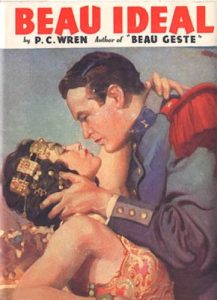
_Title:_ Beau Ideal
_Date of first publication:_ 1928
_Author:_ Percival Christopher Wren (1875-1941)
_Date first posted:_ Sep. 26, 2014
_Date last updated:_ Sep. 26, 2014
Faded Page eBook #20140933
This ebook was produced by: Marcia Brooks, Mardi Desjardins, Alex White
& the online Distributed Proofreaders Canada team at
http://www.pgdpcanada.net
BEAU IDEAL
=_BY THE SAME AUTHOR_=
BEAU GESTE
BEAU SABREUR
BEAU IDEAL
GOOD GESTES
SOLDIERS OF MISFORTUNE
THE WAGES OF VIRTUE
STEPSONS OF FRANCE
SNAKE AND THE SWORD
FATHER GREGORY
DEW AND MILDEW
DRIFTWOOD SPARS
THE YOUNG STAGERS
_All rights reserved_
B E A U I D E A L
BY
PERCIVAL CHRISTOPHER WREN
“Judge not the Play, before the Play is done
Her plot hath many changes: every day
Speaks a new scene; the last act crowns the Play.”
_Hank_: “All a matter of what’s your own private
‘_Bo Ideal_’ as they call it. . . .”
_Beau Sabreur._
L O N G M A N S , G R E E N A N D C O .
2 1 0 V I C T O R I A S T R E E T , T O R O N T O
First Edition . . . _July 1928_
_Reprinted_ . . . . _July 1928_
_Cheaper Edition_ (3/6) . _September 1929_
DEDICATED TO
WILLIAM FARQUHARSON
THE
GOD-FATHER
OF
BEAU GESTE
CONTENTS
Prologue
The Story of Otis Vanbrugh
Epilogue
The Song of the Legion
NOTE
This book, while a complete and self-contained novel, is the
last of the trilogy—_Beau Geste_; _Beau Sabreur_; _Beau Ideal_.
PROLOGUE
The heat in the _silo_ was terrific, and the atmosphere terrible.
A whimsical remark from the man they called Jacob the Jew, to the effect
that he wondered whether this were heat made black, or blackness made
hot, remained unanswered for some minutes, until a quiet voice observed
in good French, but with an English accent:
“It is the new heat, Jacob. Red hot and white hot, we know. We are now
black hot…. And when I have to leave this quiet retreat I shall take a
chunk of the atmosphere … a souvenir … keep it in my haversack.”
The man spoke as one who talks against time—the time when sanity or
strength shall have departed.
“Good idea,” mused another voice with a similar accent. “Send a bit to
one’s National Museum, too…. You an Englishman?”
“Yes,” replied the other. “Are you?”
“No … American,” was the reply.
* * * * *
Silence.
* * * * *
The clank of irons and a deep groan.
“Oh, God,” moaned the wounded Spaniard, “do not let me die in the
grave…. Oh, Mother of God, intercede for me. Let me die above ground.”
“You are not going to die, Ramon,” said the Englishman.
“No indeed,” observed Jacob the Jew. “Certainly not, good Ramon. No
gentleman would die here and now…. You would incommode us enormously,
Ramon…. I go the length of stating that I absolutely do prefer you
alive—and that’s the first time you’ve heard _that_, Ramon…. Worth
being put in a _silo_ for.”
“That’s enough, Jacob,” said the Englishman; “hold your tongue.”
The irons clanked again, as though the sick man turned in the direction
of the last speaker.
“You’ll keep your promise, Señor Caballero?” moaned the dying man. “You
_have_ forgiven me?… Truly?… You’ll keep your promise?… And the
Mother of God will come Herself and tend your death-bed…. If you
don’t, my dying curse shall blast …”
“I’ll see to it, Ramon,” said the Englishman quietly. “Don’t bother
about cursing and blasting….”
“You’ll see that I die kneeling!… You won’t let me die until I kneel
up?… You’ll hold my hands together in prayer … my head low bowed
upon my breast?… And then you’ll lay me flat and cross my hands and
make the Sign of the Cross upon my forehead….”
“As I promised, Ramon.”
“You’ll let God _see_ that I fear Him…. _He wouldn’t mistake me for my
brother?_… He wouldn’t visit my brother’s sins on _me_?”
“God is just,” said the Englishman.
“Yes, my poor Ramon,” observed Jacob the Jew, “I greatly fear that
you’ll find God just…. But don’t say that you have a brother, Ramon?”
“_Nombre de Dios_, but I have, _hombre_!…” gabbled the Spaniard. “And
he is in Hell … _Seguramente_…. He was an enemy of God…. He hated
God…. He defied God…. And God took him and broke him…. _Caramba!_
It is not fair the way God … _Yes_…. _Yes_…. _Yes_…. It _is_
fair, and God is good, kind, loving and—er—just.”
“Yes. _Just_—Ramon,” said Jacob.
“If I could find your nose, my friend,” said the American, turning in
the direction of the last speaker, “I would certainly pull it.”
“I will strike a match for you later,” replied Jacob, a man famous among
the brave for his courage; brilliantly clever, bitterly cynical, and
endowed with a twofold portion of the mental, moral and physical
endurance of his enduring race.
“God will not punish me for my brother’s sins, will He, Señor Smith?”
continued the Spaniard.
“No,” replied the Englishman, “nor him for his own.”
“Meaning him, or Him?” inquired Jacob softly.
“We punish ourselves, I think,” continued the Englishman, “_quite_
sufficiently.”
“_Mon Dieu!_” said a cultured French voice, “but you are only partly
right, _mon ami_. Woman punishes Man, or we punish ourselves—through
Woman.”
“Bless ourselves, you mean,” said the Englishman and the American
immediately and simultaneously.
“The same thing,” replied the Frenchman. And the utter stillness that
followed was broken by a little gasping sigh that seemed to shape a
name—“_Véronique_.”
“_Basta!… My brother!… My brother!_…” babbled the Spaniard and
sobbed, “God will distinguish between us…. _Gracias a nuestra Madre en
el cielo! Gracias a la Virgen Inmaculada…. Un millón de gracias._…”
“And what of this accursed brother? Surely no brother of _yours_
committed an interesting sin?” inquired Jacob.
“_Cá!_ It was the priest’s fault,” continued the Spaniard, unheeding.
“We were good enough boys…. Only mischievous…. Fonder perhaps of the
girls and the sunshine and the wine-skin and the bull-ring than of
religion and work…. My brother _was_ a good boy, none better from
Pampeluna to Malaga—if a little quick with his knife and over-well
acquainted with the smuggler track—until that accursed and hell-doomed
priest … No! No! No!… I mean that good and holy man of God—cast his
eye upon Dolores….
“Oh, Mother of God! _He killed a priest…._ And he defied and
challenged God…. And I am his twin brother!… God may mistake me for
him.”
“God makes no mistakes, Ramon,” said the Englishman. “Excuse my playing
the oracle and Heavy Father, but—er—you can be quite sure of that, my
lad.”
“Yes, yes, yes—you’re right. Of course you are right! How should God
make mistakes?… Besides, God knows my brother, _well_. He followed
him…. He warned him…. When he swore he would never enter a church
again, God flung him into one…. When he swore he would never kneel
again, God struck him to his knees and held him there…. Because he
swore that he would never make the Sign of the Cross, God made a Sign of
the Cross, _of_ him.”
“Quite noticed the little man, in fact,” observed Jacob the Jew. “Tell
us.”
“My brother caught the priest and Dolores…. In the priest’s own
church…. My brother married them before the altar … and their
married life was brief!… But of course, God knew he was mad…. As he
left that desecrated church, he cried, ‘_Never will I enter the House of
God, again!…_’
“And that very night the big earthquake came and shattered our village
with a dozen others. As we dashed through the door—the old mother in my
brother’s arms, my crippled sister on my back—the roof caved in and the
very road fell from before our little _posada_, down the hillside. My
brother was in front and fell, my mother still in his arms…. And where
did he recover consciousness? Tell me that!… _Before the altar_, upon
the dead body of his victim, the murdered priest—who thus saved my
brother’s life, for he had fallen thirty feet from the half-destroyed
church-roof, through which he had crashed…. Yes, he had entered the
House of God once more!…
“It was to South America that he fled from the police—to that El Dorado
where so many of us go in search of what we never find. And there he
went from worse to worse than worst, defying God and slaying man … and
woman! For he shot his own woman merely because she knelt—just went on
her knees to God…. And one terrible night of awful storm, when fleeing
alone by mountain paths from the soldiers or _guardias civiles_, a flash
of lightning showed him a ruined building, and into it he dashed and
hid.
“It may have been the rolling thunder, the streaming rain, or an
avalanche of stones dislodged by the horses of the police who passed
along the path above—I do not know—but there was a terrible crash, a
heavy blow, a blinding, suffocating dust—and he was pinned, trapped,
held as in a giant fist, unable to move hand or foot, or head….
“And, when daylight came, he saw that he was in a ruined chapel of the
old _conquistadores_, kneeling before the altar—a beam across his bowed
shoulders and neck; a beam across his legs behind his knees; a mass of
stone and rubble as high as his waist…. And there my brother
_knelt_—before the altar of God—in that attitude of prayer which he
had sworn never to assume—and thought his thoughts…. For a night and
a day and a night, he knelt, his stiff neck bent, but his brave heart
unsoftened…. And thus the soldiers found him and took him to the
_calabozo_….
“The annual revolution occurred on the eve of his garroting, and he was
saved. Having to flee the country, he returned to Spain, and sought me
out…. Owing to a little smuggling trouble, in which a _guardia civil_
lost his life, we crossed into France, and, in order to get to Africa
and start afresh, we joined the Legion….
“_Válgame Dios!_ In the Legion we made quite a little name for
ourselves—not so easy a thing to do in the Legion, as some of you may
know. There they fear nothing. They fear no thing, but God is not a
thing, my friends. _Diantre!_ They fear neither man nor devil, neither
death nor danger—but they fear God…. Most of them…. When they come
to die, anyhow.
“But my brother did not fear God…. And his _escouade_ of devils
realized that he was braver than they … braver by that much…. And
always he blasphemed. Always he defied, insulted, challenged God. He had
a terrible fight with Luniowski the Atheist, and Luniowski lost an eye
in the defence of his No-God. My brother fought with awful ferocity in
defence of his God—the God he _must_ have, that he might hate and
revile Him—the God Who had sat calmly in His Heaven and watched Dolores
and the priest….
“In Africa there was little fear of his finding himself flung into a
church, or pinned on his knees before a chapel altar! We aren’t much
troubled with chaplains and church-parades in the Legion!
“But one day my brother saw a lad, a boy from Provence, a chubby-faced
child, make the Sign of the Cross upon his breast, as we were preparing
to die of thirst, lost in a desert sand-storm…. My brother, with all
his remaining strength, struck him upon the mouth.
“ ‘_Sangre de Cristo!_ If I see you make that Sign again,’ he croaked,
‘I’ll do it on you with a bayonet.’…
“ ‘If we come through this, I _will_ make the Sign of the Cross on you
with a bayonet,’ gasped the boy hoarsely, and my brother laughed.
“ ‘Try,’ said he. ‘Try when I’m asleep. Try when I’m dying…. Try when
I’m dead…. Do you not know that I am a _devil_? Why, your bayonet
would melt…. _Me!_ The Sign of the Cross!… _God Himself could not do
it!_’
“And next day my brother was lost in that sand-storm, and the Touareg
band who found him, took him to the Sultan of Zeggat…. And the Sultan
of Zeggat _crucified_ him in the market-place, ‘as the appropriate death
for a good Christian!’… Wasn’t that humorous!…”
* * * * *
Silence.
* * * * *
“Yes, God made a Sign _of_ my brother,” said Ramon the Spaniard, and
added, “Help me to my knees, Señor Smith, and keep each word of your
promise, for I think I am dying.”
* * * * *
Silence….
* * * * *
And then a cry of “_Dios aparece_” from the dying man.
Jacob the Jew, great adept at concealment, produced matches and struck
one.
* * * * *
The flare of the match illumined a deep-dug pit, its floor hard-beaten,
its walls sloping to a small aperture, through which a star was visible.
It had been dug and shaped, for the storing of grain, by Arabs following
a custom and a pattern which were old in the days when Carthage was
young.
It was now stored, not with grain, but with men[1] sentenced to
punishment beyond punishment, men of the Disciplinary Battalions, the
_Compagnies de Discipline_, the “_Joyeux,_” the “_Zephyrs_,” the
_Bataillion d’Infanterie Légère d’Afrique_—convicted criminals.
The light from the burning match revealed a picture worthy of the pencil
of the illustrator of Dante’s _Inferno_—a small group of filthy,
unshorn, emaciated men, clad in ragged brown canvas uniforms which, with
the grime upon their flesh, gave them the appearance of being already
part of the earth to which they were about to return, portions of the
living grave in which they were entombed.
Some lay motionless as though already dead. One or two sat huddled,
their heads upon their clasped knees, the inward-sloping sides of the
_silo_ denying them even the poor comfort of a wall against which to
lean.
Beside a large jug which held a little water, a man lay upon his face,
his tongue thrust into the still-damp earth where a few drops of water
had been spilt. He had drunk his allowance on the previous day.
Another looked up from his blind search, with sensitive finger-tips, for
grains of corn among the dirt.
As Jacob held the match aloft, the Englishman and the American gently
raised the body of Ramon the Spaniard from the ground. It was but a
body, for the soul had fled.
“Too late,” said Jacob softly. “But perhaps _le bon Dieu_ will let him
off with eight days’ _salle de police_ in Hell, as it wasn’t his fault
that he did not assume the correct drill-position for dying
respectfully….
“No use heaving him up now,” he added, as the head rolled loosely
forward.
Without reply, the Englishman and American lifted the dead man to his
knees, and reverently did all that had been promised.
And when the body was disposed as Ramon had desired, Jacob spoke again.
“There are but five matches,” he said, “but Ramon shall have two, as
candles at his head and feet. It would please the poor Ramon.”
“You’re a good fellow, Jacob,” said the Englishman, “… if you’ll
excuse the insult.”
Jacob struck two matches, and the Englishman and the American each
taking one, held it, the one at the head, the other at the feet, of the
dead man.
All eyes were turned to behold this strange and brief lying-in-state of
the Spanish smuggler, court-martialled from the Legion to the Zephyrs.
“Pray for the soul of Ramon Gonzales, who died in the fear of God—or,
at any rate, in the fear of what God might do to him,” said Jacob the
Jew.
The Frenchman who had observed that Man’s punishment was Woman,
painfully dragged himself into a sitting posture and crawled toward the
body.
“I have conducted military funerals,” said he, “and remember something
of the drill and book-of-the-words.”
But what he remembered was not available, for, after the recital of a
few lines of the burial-service, he fainted and collapsed.
“This is a very nice funeral,” said Jacob the Jew, “but what about the
burial?”
—–
Footnote 1:
A prohibited and illegal form of punishment.
§2
Suddenly a man leapt to his feet and, screaming insanely, beat the wall
with his manacled hands.
“Come! Come! Smolensky” soothed the huge grey-haired Russian who had
been Prince Berchinsky. “We mustn’t lose our heads, comrade…. I nearly
lost mine once…. Sit down…. I’ll tell you about it…. Hush now!…
Hush! And listen…. Yes … I nearly lost my head once. It was offered
as a prize! Think of that! There’s an honour for you!
“It was like this…. I was with Dodds’ lot at Dahomey, you know. He was
almost a nigger himself, but he was a soldier all-right, believe me.
Faraux was our Battalion-Commander and General Dodds thought a lot of
him—and of us. It quite upset Dodds when Faraux was killed at the
battle of G’bede, but he kept the Legion in front all the same…. So
much in front that he lost me, _le Légionnaire_ Badineff….
“I was with a small advance-guard and we were literally pushing our way
through that awful jungle when the Amazons ambushed us…. Wonderful
women those Amazons—far better fighters than the men—braver, stronger,
cleverer, more soldierly…. Armed with short American carbines and
_coupe-coupes_, they’re no joke!
“I don’t want to fight any better troops…. Not what you’d call good
shots, but as they never make the range more than about twenty yards,
they don’t miss much!…
“Well, it wasn’t many minutes before I was the only man of the
advance-guard who was on his feet, and I wasn’t on those long…. For
these she-devils were absolutely all round us, and as three or four
rushed me with their _machetes_, one of them smashed me on the head,
from behind, with the butt of her carbine…. Quite a useful bump too,
_mes amis_ … for it put me to sleep for quite a while….”
“Lost your head, in fact,” put in Jacob the Jew.
“No, no,” continued the old Russian, “not yet … but I nearly lost my
wits when I recovered my senses … if you understand me…. For the
ladies had divided my property among them to the last rag of my shirt,
and were now evidently turning to pleasure after business.
“Dahomeyan is not one of the languages which I speak…. I only know
fourteen really well … so I could not follow the discussion
closely…. But it was quite clear that some were for fire and some for
steel…. I think a small minority-party were for cord…. And I was
under the impression that one merry lass capped the others’ laughing
suggestions with the proposal for all three!…
“Do you know, it was for all the world like a lot of nice little girls
sitting on the lawn under the trees with their kitten, joyously
discussing how they should dress him up, and which ribbons they should
put round his neck….
“You know how they laugh and chatter and pull the kitten about, and each
one shouts a fresh idea about the dressing-up and the ribbons, and the
fun generally…. Well, those nice little girls discussed dressing
me—for the table—though it wasn’t a ribbon they proposed putting round
my neck…. And undeniably they pulled me about!…
“I could not but admire the way they had tied me up…. I was more like
a chrysalis in a cocoon than a bound man…. They _were_ playful….
Good actresses too—as I realized afterwards…. When they saw that I
had come round, one of them, eyeing me archly, drew her finger across
her throat, and the others all nodded their approval.
“The young thing got up, took a bright sharp knife from her waist-belt,
and came over to where I lay against the bole of a tree.
“Grabbing my throat with her left hand, she pulled up the loose skin and
began to cut, just as the Leading Lady called out some fresh
stage-directions—whereupon she grabbed my beard, pulled my head over to
one side, and put the point of the knife in, just below my ear…. I
closed my eyes and tried to think of a prayer….
“When it comes to it, having your throat cut is the nastiest death there
is….
“And just as I was either going to pray or yell, there was a loud burst
of laughter, and the girl went back to her place in the jolly group….
The Leading Lady then, as far as I could make out, said:
“ ‘Now we must really get to business or the shops will be shut’ … and
told another lassie, who possessed a good useful iron-hafted spear, to
put the butt-end of it in the fire, explaining why, with appropriate
gesture….
“It was evidently quite a good idea, for the girls all laughed and
clapped their hands, and said what a nice party it was….
“While the spear was getting hot, they propounded all sorts of other
lovely ideas, and, over the specially choice ones, they simply rocked
with merriment…. It _did_ seem a pity that one couldn’t follow all the
jokes…. When the pointed haft of the spear was glowing nicely, its
owner picked it up, and stepping daintily across to me, held the point a
few inches from my eyes….
“Not unnaturally, I turned my head away, but, saying that that wasn’t
fair, the Leading Lady and the Soubrette made one jump for me and
grabbed my head….
“Fine strong hands and arms those ladies had…. I couldn’t move my face
a fraction of an inch….
“And slowly … slowly … slowly … that red-hot point came nearer and
nearer to my right eye…. It seemed to approach for hours, and it
seemed to be in the centre of my brain in a second….
“When it comes to it, _mes amis_, having your eyes burnt out with a
red-hot spear-haft is the nastiest death there is….
“But when my right eye seemed to sizzle and boil behind its closed lid,
and to be about to burst, my young friend changed her mind, and began
upon the left … and when the iron was just about to touch it she
remarked, in choice Dahomeyan, I believe:
“ ‘Dammit! The blooming iron’s cold!’ and, with a joyous whoop, bounded
back to the fire, and thrust it in again….
“Shrieks of laughter followed, and loud applause from the cheap seats.
“Meanwhile the ladies hanged me….”
“_Hanged_ you?” inquired Jacob the Jew. “Don’t you mean they cut your
head off?… You said you lost your head, you remember.”
“No, my friend,” replied Badineff, “I said I _nearly_ lost it…. Not
completely—as you have lost your manners…. What I am telling you is
true…. And if you don’t like it, pray go elsewhere….”
“There’s nowhere to go but Heaven, I’m afraid,” was the reply … “being
in Hell—and Earth being denied to us…. But pray finish your story, as
it is unlikely we shall meet in Heaven….”
“Yes…. They hanged me as neatly and as expeditiously as if they had
had the advantage of an education in Christian customs…. They simply
jerked me to my feet, made a noose in a palm-fibre cord, threw the end
over the limb of a vast tree, hauled upon it and danced around me as I
hung and twisted….
“They say a coward dies many times…. That was undoubtedly one of the
occasions upon which I have died….
“When it comes to it, _mes amis_, being hanged by strangulation—and not
by mere neck-break—is one of the nastiest deaths there is….
“But evidently they let me down in time and loosened the rope from about
my neck, for bye-and-bye I was staring up at the stars and in full
enjoyment of all my faculties…. Particularly the sense of smell….
“The intimate smell of Negro, in bulk, is like no other smell in the
world…. There is nothing else like it, and there is nothing to which
one can compare it—and here is a curious fact which should interest the
psycho-physiologist…. Whenever I wake, as we of the Zephyrs do, dumbly
sweating or wildly shrieking, from a ghastly nightmare, I can always
_smell_ Negro, most distinctly…. Very disgusting….
“Curiously enough, these fearless savage fiends, who will charge a
machine-gun with the utmost bravery and with a spear, are arrant cowards
at night … in mortal fear and trembling horror of ten thousand
different devils, ghosts, djinns, ghouls, goblins and evil spirits….
And when I came to, they were huddled around me for protection. I was
almost crushed and buried beneath the mass of them as they lay pressed
round and across me….
“As I was still most painfully bound, I can only suppose that I was, in
myself, a talisman, a _juju_, a mascot, or shall I say, an _ikon_.
“And they had gathered around me in the spirit in which simple peasants
might gather round a Calvary, and were using me as some might use a
Cross, a holy relic or a charm….
“Yes, to this day I smell that dreadful odour—dreadful because of its
associations, rather than of itself—in my worst nightmares and delirium
of fever or of wounds….
“I can smell it at this moment….
“I have passed some bad nights—one, impaled on bamboo stakes at Nha-Nam
in Tonkin—but this was the worst night of my life … almost….
“And in the morning the ladies awoke, made no toilette, and gave me no
food….
“But they had given me a faint hope, for I could not but realize that,
so far, they had only tortured me by not torturing me at all—and it
seemed that they might be keeping me, not only alive and whole, but
without spot or blemish, for some excellent purpose….
“They were!…
“And when I discovered it, I was inclined to wish that they had killed
me with fire or steel or cord—as they did all of our men whom they took
prisoner….
“For some reason, possibly on account of my unusual size—I was a fine
specimen in those days, six foot six, and with golden hair and
beard—they were taking me to good King Behanzin at Kana, as an
acceptable gift for a burnt-offering and a bloody sacrifice unto his
gods and idols….
“There was a story afterwards, that Behanzin had been told by his
sooth-sayers and medicine-men, that he would undoubtedly beat the French
if a strong _juju_ were made with the blood of a white cock that had a
golden comb…. One of our officers, Captain Battreau, said I probably
owed my life to my golden comb…. I have a very white skin where I am
not sunburnt….
“Anyhow, the ladies took me along—by the inducement of _machete_-points
and rhinoceros-hide whips chiefly—to Kana….
“I don’t know whether we marched for a day or for a week…. Yes…. I
was strong in those days … for I believe I ate nothing but raw
carrion, and my arms were bound to my body the whole time, as though
with wire….
“Kana stands on a hill and is built of earth, clay, and sun-baked
bricks, inside a great high wall, yards in thickness….
“We entered through a gate like a tunnel, and, by way of filthy narrow
red-earth streets, came to a second, inner wall, which surrounded the
royal palaces, _hareems_, temples, and the House of Sacrifice….
“The yelling mob that had accompanied us from the outer gate, crowding
and jeering and throwing muck at me—though they kept well out of reach
of the weapons of the Amazons—evidently feared to enter this inner
city, for that is what it amounted to….
“And I was handed over to a guard of long-speared ruffians and filthy
priests who slung me into a big building and slammed the huge double
gates…. As I staggered forward in the darkness, I slipped on the
slimy, rounded cobble-stones, sprawled full-length and collapsed….
“There was a loud roaring in my ears—not the conventional roaring in
the ears of a fainting man, but the buzzing of millions of billions of
trillions of huge flies, that soon so completely covered me that you
could not have stuck a pin into my body without killing one. Their
blue-grey metallic bodies made me look as though I were clad in a
complete suit of chain-mail…. And I could not move a finger even to
clear my eyes…. I could only blink them.
“And as my eyes grew accustomed to the gloom, I saw that the whitish
gleaming cobble-stones were the skulls of men, sunk in the red earth….
And I realized why I was being nauseated by a terrible slaughter-house
stench….
“It _was_ a slaughter-house…. The House of Sacrifice, of Kana, the
Sacred City of King Behanzin of Dahomey….
“That was another unpleasant night, _mes amis_…. Oh, quite
unpleasant…. We are in clover here—pigs in clover…. But,
mercifully, I was at the end of my tether, and I had now so little
capacity for suffering, that I was not clear in my mind as to whether
certain things that happened that night were real or imaginary, fact or
nightmare….
“They were real enough…. And in the morning I found I was, even as I
had either dreamed or realized—actually inside a great wicker bottle or
basket, from the top of which my head protruded….
“I could not move a single muscle of my body save those of my face….
“The priests and executioners had been busy during the night, and I was
now like a mummy in its bandages, neatly encased in the Sacrificial
Basket, all ready to play my helpless part in the bloody ritual of their
unspeakable religion….
“Half-dead as I already was, my one hope was that the Service would be
short and early—the sacrifice soon and quick…. It is most
uncomfortable to lie in a bottle with nothing to support your head….
“I could see nothing, and hear little, by reason of the huge flies …
but I was aware of tom-toming and shouting without, and hoped that it
concerned me…. It did…. The gates of the House of Sacrifice were
thrown open and a number of guards, priests, and executioners heaved me
up from that terrible floor and carried me outside.
“Oh, the sweetness of that morning air—even in an African town…. It
almost made me want to live…. And oh, the relief to have one’s head
freed from an inch-thick covering of flies….
“The great Square of the inner town—a Square of which the sides were
formed by, shall we say, the Palaces, Cathedrals, Convents, Monasteries
and Municipal Buildings of King Behanzin—was thronged by hundreds and
hundreds of warriors, both men and women. As my guards carried me across
to the biggest of the buildings, all these people fell back to the sides
of the Square, leaving the centre empty, save for me and my guards.
“In front of the palace, an ugly clumsy building of red earth and baked
clay bricks, sat Behanzin, King of Dahomey, on the Royal Stool. Around
him were grouped his courtiers…. I think that His Majesty and they
formed one of the least pleasing groups of human beings I have ever
encountered—and I have known quite a lot of kings and their
ministers….
“As I have already observed, I do not speak Dahomeyan, and at that
moment I deeply regretted the fact, and equally so, that none of them
understood Russian or even French…. However, French I spoke, in the
vain hope that a word or two, here and there, might be understood.
“A few were, as I will tell you….
“My speech was brief and blunt…. I told Behanzin that he was the
nastiest king I knew … the ugliest … the foulest … the filthiest
… the most abandoned and degraded…. And I should be much obliged if
someone would remove me from a world which he contaminated….
“I had not finished even these few and well-chosen words before I was
again seized by my porters and carried to the very centre of the Square,
and there abandoned.
“Immediately the Public, obviously well accustomed to these out-door
sports and pastimes, fell into perfectly straight lines on each of the
sides of the Square, and assumed the position of sprinters at the
starting-point of a race—but each with a _coupe-coupe_, knife, axe or
spear in his right hand—and looked to His Majesty for the signal.
“The King rose from his royal stool, raised his spear aloft and gazed
around….
“I also gazed around, having just grasped the underlying idea of the
National Sport, a game in which I had never hitherto taken part, nor
even seen….
“Of course—how stupid of me—it was a race-game, a go-as-you-please,
run-walk-hop-or-jump…. And my head was the prize!
“I wondered whether His Majesty had gathered that my brief address was
not couched in diplomatic language…. He certainly now prolonged what
was, to me, a painful moment…. He stood like an ebon statue, his white
ostrich feathers nodding in the breeze, his handsome cloak hanging
gracefully from his great shoulders, his spear uplifted, motionless….
“When that spear fell, I knew that every competitor of those hundreds
surrounding me, would bound forward like a greyhound unleashed. For a
few seconds I should see them race toward me, their bloodthirsty faces
alight with the lust of slaughter, their gleaming weapons raised
aloft…. And I should go down, the centre of a maelstrom of clutching
hands and hacking blades….
“I wondered what would be the reward of the proud winner of the King’s
Trophy—the head of the white cock with a golden comb … the essential
ingredient for the making of the strong _juju_ that was to defeat the
French….
“That black devil, Behanzin, stood steady as a rock, and there was
absolute silence in that great Square, as all awaited the fall of the
flag, or rather the shining spear-head….
“A woman, standing in a doorway, giggled nervously, and a crouching
sprinter, presumably her lord, looked back over his shoulder—only to
receive her sharp rebuke for taking his eye off the ball….
“Another woman dashed forward and handed her husband a _machete_, taking
his spear back into the hut…. I imagined his saying to her, just
before he left the house, ‘Tatiana, my dear, run upstairs and find that
new _machete_ I ordered last week…. I think it’s on the top of the
wardrobe in my dressing-room, unless that wretched girl has put it
somewhere.’…
“And then I glanced again at the King…. Even as I did so, the raised
spear-head, which probably had only been uplifted for five seconds after
all, began to travel slowly backward…. And there was an audible
intaking of breath…. Evidently the giving of the signal had begun, and
in the fraction of a second, the broad, bright spear-head would come
flashing downward….
“I closed my eyes….
“_Boom … BANG!_
“I nearly jumped out of my bottle….
“_Boom … BANG!_
“Two shells had burst in Kana, one just above the inner wall, the other
in the corner of the Square itself….
“Our guns!… Our guns!…
“The runners were running indeed—for their _own_ heads…. King
Behanzin ‘also ran’ … if indeed he did not get a win or a place….
“I was forgotten … before ever the third and fourth shells arrived….
Oh, God! I was _not_ forgotten!… There was _one_ competitor left!… I
supposed he felt attracted by the walk-over…. As he dashed toward me,
straight as an arrow, yelling madly, a great spear in his hand, I saw
that he was one of the group of courtiers … the man indeed who had
stood nearest to the King….
“I admit, _mes amis_, that it seemed to me a little hard, more than a
little hard, that with the flight of all those hundreds and hundreds of
murderous slayers, this solitary one should prefer my life to his own
… should not realize that the match was abandoned … the race
scratched … the proceedings postponed….
“A fellow of one idea…. A case of the _idée fixe_…. No sportsman,
anyhow…. The sort of man that steals the Gold Cup….
“I had been through so much, _mes amis_, from the time that that Amazon
had hit me on the head, that I really rebelled a little at this last
cruelty of a mocking Fate.
“Saved by the bursting of the shells at the fifty-ninth second of the
fifty-ninth minute of the eleventh hour, and then this one solitary,
implacable madman to fail to realize that I had been saved!…
“Nearer … nearer … he came—and by the time that he was a few yards
from me, he and I were alone in that great Square….
“Would he drive that huge spear through my body, and then clumsily hack
my head off with the edge of its broad blade?
“How I hoped that the next shell would blow his limbs from his body,
though it killed me too…. Another bound and he would be on me…. I
closed my eyes—and the Nightmare Slayer flung his arm round me, and, in
execrable French, panted:
“ ‘You tell Frenchies I be verra good man, massa…. I belong Coast …
belong French shippy…. I good friend loving Frenchies…. I
interpreter…. I show Frenchies where old Behanzin bury gin, rum,
brandy, ivory….’
“Another shell burst…. And the Nightmare Slayer tipped my basket over,
and, flat upon the ground, the lion and the lamb lay down together….
“That, _mes amis_, was how I nearly lost my head….
“We must not lose ours here, for, as you perceive, there are far worse
places than this one…. I rather like it….”
§3
A long heavy silence was broken by Jacob the Jew.
“The lad we want here is the bold bright Rastignac … Rastignac, the
Mutineer….”
“Oh, did you know him?” said the Englishman.
“What _about_ him?” asked the Frenchman.
“What about him? Ho, ho!… He gave the Government some trouble, one way
and another…. They stuck him in the Zephyrs, but they didn’t keep him
long. What do you think he did?…
“He used to carry a flexible saw-file round his upper gums from one
cheek to the other, and they _say_ he carried some little tool that he
used to swallow—on the end of a string, with the other end tied round a
back tooth—on search days.
“Well, he filed his manacles and got out…. And he killed two sentries,
absolutely silently, by stabbing them in the back of the neck with a
long darning-needle, to which he had fitted a tiny wooden handle….
There is a spot, you know, at the base of the brain, just where the
skull rests on the backbone…. The point of a needle in _there_ …
just in the right spot … and _pouff_!…
“Rastignac knew the spot, all-right. And when he was clear, and dressed
in a dead sentry’s uniform, did he run off like any other escaping
prisoner?… Not he…. He broke into a Public Works Department shed …
took a pot of black paint, and a pot of white, and some brushes, and
marched off at daybreak, as bold as brass….”
“Where to?” inquired the American.
“To the nearest milestone,” chuckled Jacob the Jew, “… and neatly
touched up the black _kilometre_ figures and their white border…. And
then to the next…. And the next….
“When patrols passed, he gave them good-day and exchanged jokes and the
latest news, for cigarettes and a drink…. They say he visited several
camps and made himself useful, with his paint, to one or two officers,
and reported some rascal who had smeared one of his nice black figures
because he wouldn’t give him tobacco!…
“And so he painted his way, milestone by milestone, to Oran, where he
reported himself, produced the dead sentry’s _livret_ and leave-papers,
and was wafted comfortably, by _Messageries Maritimes_, to France….”
“Well, and what would he do if he were here?” asked a querulous voice.
“We may suppose that your Rastignac had neither the wings nor feet of a
fly…. And if he were here and got us out, where could we go?… More
likely to have caused the death of us all…. Like those two devils
Dubitsch and Barre nearly did to their gang….”
“What was that?” asked Badineff.
“Why, these two unutterable swine were with a working-party in the _zone
dissidente_, and at night were in a little perimeter-camp made with dry
cactus and thick heavy thorn…. Their beautiful scheme—and they nearly
brought it off—was to creep out on a windy night and to set fire to
these great thorn-walls of the zareba! This stuff burns like paper, and
they’d got hold of some matches…. It mattered nothing to them that the
remaining ninety-eight of their fellow-convicts would inevitably be
roasted to death in the process…. Those two would easily escape in the
confusion, while the men of the escort were vainly doing their best to
save the rest of the wretched prisoners…. _Their_ position, as you may
imagine, would be just that of a bundle of mice tied together by their
tails and packed round with cotton-wool soaked in kerosene….
“As luck would have it—the luck of the other ninety-eight, anyhow—the
first match was blown out, and a sentry had seen the glare of it…. He
fired and challenged after, wounding Dubitsch and so flustering Barre,
who had the matches, that he dropped the lot and was unable to strike
another before the sentry was upon him….”
“What happened then?” asked the Englishman.
“The Sergeant-Major in charge of the escort simply returned them to
their place in the gang—but took care that the gang should know exactly
what had happened….”
“And then?…” prompted the Englishman, when the man stopped, as one who
had said enough….
“Oh—they died … they died…. They died that same night, of something
or other…. Judging from their faces, they had not died happily….”
“Sounds as though you saw them,” observed Jacob the Jew.
“Quite,” observed the narrator laconically.
“Not like poor dear little Tou-tou Boil-the-Cat,” observed Jacob.
“What happened to him?” asked the Querulous Voice.
“Oh, he died … he died…. He died suddenly, one night, of something
or other…. But no-one was able to judge from his face whether he died
happily or not….”
“Tell us about him,” suggested the American.
“About Tou-tou Boil-the-Cat?… He wasn’t a nice man…. Made quite a
name for himself, Montmartre way, before he went to the Legion…. There
was some talk about a Lovely Lady, the Queen of his Band…. Wonderful
golden hair…. Known to all kind friends as _Casque d’Or_…. They say
he cut it off…. Her head, I mean…. Got into bad trouble in the
Legion too…. Life sentence in the Zephyrs….
“A brave little man, but he hadn’t the other virtue that one rather
demands…. No…. Something of a stool-pigeon…. There were thirteen
convicts in a tent … a most unlucky number … but it was soon reduced
to twelve, through M’sieu Tou-tou Boil-the-Cat giving information that
affected the career—indeed, abbreviated it—of one of his comrades….
“Yes … thirteen went forth from that tent to labour in the interests
of France’s colonial expansion that sunny morning, and only twelve
returned to it, to sleep the sleep of the unjust, that dewy eve…. A
round dozen….
“But they did not sleep through the stilly night, though the night
remained quite stilly…. And behold, when another bright day broke,
those twelve were now eleven….
“The guard, who was but a simple peasant man, could _not_ make the count
come to more than eleven…. The corporal—possibly a shade more
intelligent, could not by any means make the count a dozen…. The
Sergeant, a man who could count quite well, swore there were but ten and
one…. Not the Commandant himself could make us twelve!…
“With the help of a bottle of absinthe he might make us twenty-two—but
even then he realized that he should have seen twenty-four….
“No…. Tou-tou Boil-the-Cat was gone…. Gone like a beautiful dream
… or like the foul brutish nightmare that he was….
“And that, you know, puzzled our kind superiors….
“For, as it happened, it was quite impossible for anyone to have escaped
from the camp that night—full moon, double sentries, constant patrols,
and all-night wakefulness and uneasiness on account of expected Arab
attack….
“But gone he had….
“We were interrogated severally, and collectively, and painfully …
until they must have admired our staunchness and the wonderful
cleverness of the missing man….
“We eleven slept in the tent for a month … and the country round was
scoured until not one grain of sand was left upon another, and there was
not a locust, a scorpion, a serpent nor a vulture, whose _dossier_ was
not known….
“And at the end of a month the whole camp moved on….”
“Did they ever find him?” asked Badineff.
“No … _they_ didn’t,” was the reply. “The jackals found him….”
“Where?” asked the Englishman.
“Under the sand that had formed the floor of the tent of the eleven …”
was the answer.
“Sounds as though you were there …” said the Querulous Voice.
“Quite …” replied Jacob the Jew, and yawned.
§4
The sun had risen and set once more, causing a spot of light to travel
slowly across a portion of the interior of the _silo_, with the
search-light effect of illuminating brilliantly the tiny area upon which
it rested, while leaving the rest of the place in darkness darker than
that of night.
There was curiously little movement, and less sound, in the _silo_—the
uneasy stirring of a nightmare-ridden sleeper, a heavy sigh, a faint
groan, the clank of a chain. Talk had ceased, and scarcely a sentence
had been uttered for hours.
The last subject of general conversation had been that of the cause of
their abandonment to a lingering and terrible death in that dreadful
tomb. Speculation had wandered from sudden Arab attack and the
annihilation of the Company, to the familiar theory of wanton malice and
deliberate devilish punishment. Men, condemned from the Legion for
military “crimes,” had advanced the former theory; civilian prison
criminals, the latter.
The Frenchman who had attempted to recite the Burial Service had
accepted neither of these views.
“We are _forgotten_,” he had said…. “We are the Forgotten of Man, as
distinguished from our friends the Touareg, the Forgotten of God. It is
perfectly simple, and I can tell you exactly how it happened.
“As you may be aware, _mes amis_, a list of _les hommes punis_ is made
out, by the clerk of the _Adjudant_, every morning, before the guard is
changed. The form on which he writes the names is divided into columns
showing the class of punishment and the number of days each man has
still to do…. And the clerk of the _Adjudant_, God forgive him, has
written the number of our days under the heading _salle de police_, or
_cellules_, or _consigne_, and has left the column ‘prison,’ blank. So,
each day, our sentences are being reduced by one day, in those places
where we are not, and the Sergeant of the Guard for each day, observes
that there are no men in ‘_prison_,’ for the column so headed is
blank…. We are _not_ in ‘prison’ because we are not recorded as being
in ‘prison’—and therefore we cannot be released from ‘prison.’…”
And Jacob the Jew had observed:
“Convincing and very cheering…. Monsieur must have been a lawyer
before he left the world.”
And the man had replied:
“No…. An officer…. Captain of Spahis and in the Secret
Service—about to die, and unashamed…. _No!_—I should say
_Légionnaire_ Rien of the Seventh Company of the Third Battalion of the
First Regiment of the Foreign Legion…. I was wandering in my mind….”
§5
“Tell me,” said Jacob the Jew (or Jacopi Judescu, the Roumanian gypsy).
“What was really your reason for that sloppy feeble ‘kindness’ to Ramon
Gonzales…. I am a philosopher and a student of that lowest of the
animals, called Man…. Was it to please your Christian God and to
acquire merit?… Or to up-hold your insolent British assumption of an
inevitable and natural superiority?… You and your God—the Great
Forgivers!… ‘Injure me—and I’ll forgive you _and_ make you feel so
damned uncomfortable that you’ll be more injured than I am.’ … Aren’t
you _capable_ of a good decent hate or …”
“Yes. I hate your filthy voice, dear Jacob,” replied the Englishman.
“No. Tell me,” persisted Jacob. “I loathe being puzzled…. Besides,
don’t you see I’m going mad…. Talk, man…. These corpses…. Why did
you behave like that to Ramon Gonzales?… He betrayed you, didn’t
he?… I would have strangled him…. I would have had his eyes….
Didn’t he betray and denounce you after you had found him in the desert
and saved his life?… To Sergeant Lebaudy?”
“Yes. He recognized me—and did his, ah—duty,” was the reply.
“For twenty-five pieces of silver!… Recognized you as one of the
Zinderneuf men he knew at Sidi, and promptly sold you?…
“Consigned you to sudden death—or a lingering death—for twenty-five
francs and a Sergeant’s favour!… And here the Judas was—wondrously
delivered into your hand—and you ‘forgave’ him and comforted him!…
Now _why_?… What was the game, the motive, the reason, the object? Why
should a sane man act like that?… What _was_ the game?”
“No game, no motive, no reason,” answered the Englishman. “He acted
according to his lights—I to mine.”
“And where do you get your ‘lights’? What flame lit them?”
“Oh—I don’t know…. Home…. Family…. One’s women-folk….
School…. Upbringing…. Traditions…. One unconsciously imbibes ideas
of doing the decent thing…. I’ve been extraordinarily lucky in
life…. Poor old Ramon wasn’t…. One does the decent thing if one
is—decent.”
“You don’t go about, then, consciously and definitely forgiving your
enemies and heaping coals of fire on them because you’re a Christian.”
“No, of course not…. Don’t talk rot….”
“Nor with a view to securing a firm option on a highly eligible and
desirable mansion in the sky—suitable for English gentleman of
position—one of the most favourable residential sites on the Golden
Street….”
“Not in the least…. Don’t be an ass….”
“You disappoint me. I was hoping to find, before I died, one of those
rare animals, a Christian gentleman—who does all these funny things
_because_ he is a Christian—and this was positively my last chance….
I shall die in here.”
“I expect Christianity _was_ the flame that lit those little ‘lights,’
Jacob…. Our home and school and social customs, institutions and ideas
are based on the Christian ideal, anyhow…. And we owe what’s good in
them to that I believe…. We get our _beau idéal_ quite unconsciously,
I think, and we follow it quite unconsciously—if we follow it at
all….”
“Well, and what _is_ it, my noble Christian martyr?”
“Oh, just to be—decent, and to do the decent thing, y’know.”
“So, indirectly, at any rate, you returned good for evil to Judas Ramon
Gonzales because you were a Christian, you think?”
“Yes…. Indirectly … I suppose…. We aren’t good at hating and
vengeance and all that…. It’s not done…. It isn’t—decent….”
“But you puzzle me. What of Ramon the Judas … Ramon who sold you? He
was a _great_ Christian, you know…. A staunch patron of your Christian
God…. Always praying and invoking your Holy Family.”
“There are good and bad in all religions, Jacob…. I have the highest
admiration for your great people—but I have met rotten specimens….
Bad as some of my own….”
* * * * *
Silence.
* * * * *
“Look here, Christian,” began Jacob the Jew again. “If I summoned up
enough strength, and swung this chain with all my might against your
right cheek, would you turn the other also?”
“No. I should punch you on the nose,” said the Englishman simply.
* * * * *
Silence.
“Tell me. Do you kneel down night and morning and pray to your kind
Christian God, Englishman? The forgiving God of Love, Who has landed you
_here_?” asked Jacob the Jew.
“I landed myself here,” was the reply. “And—er—no…. I don’t pray—in
words—much…. You won’t mind asking questions for fear of being
thought inquisitive, will you, gentle Jacob?”
“Oh, no…. Let’s see now…. You forgive the very worst of injuries
because you are a Christian, but not _because_ you’re a Christian….
You do as you would be done by, and not as you’ve been ‘done’ by…. You
don’t pray in words, and hold daily communion with your kind Christian
God—you regard Him as a gentleman—an English gentleman of course—who
quite understands, and merely desires that you be—decent, which of
course, you naturally would be, whether He wished it or not…. And
you’ll punch me on the nose if I smite you on the cheek—but you don’t
even do that much to anyone who betrays you to a dreadful death…. And
really, in your nice little mind, you loathe talking about your
religion, and you are terrified lest you give the impression that you
think it is better than other people’s, for fear of hurting their
feelings….”
“Oh, shut up, Jacob. You’d talk the hind leg off a dog.”
“What else is there to do but talk?… And so you are perfectly certain
that you are a most superior person, but you strive your very utmost to
conceal the awful fact…. You’re a puzzling creature…. What is your
motivating force? What is your philosophy? What are you _up_ to?…”
“Well, at the moment, I’m going to issue the water-ration…. Last but
one….” said the Englishman.
“I can’t understand you English….” grumbled Jacob.
“A common complaint, I believe,” said the Englishman. The quiet American
laughed.
§6
“Should any gentleman here survive, I wonder if he would be so extremely
obliging as to write to my Mother,” said the French ex-officer later.
“She is an old lady—quite alone—and she foolishly cherishes a fondness
for a most unworthy son…. Darling Mother!…”
The Englishman and the American memorized an address in Paris, and each
declared that he would not only write to Madame de Lannec, but would
visit her, give her her son’s last message, and assure her of his gentle
happy death from honourable wounds received in the service of France,
and describe his grand military funeral.
Neither of these two men would admit that he also was already in his
grave.
“Been in lots of tighter places than this,” said the Englishman.
“I’ve been nearer death too,” observed the American. “Been dead
really…. In this same Zaguig….”
“Ah—an unpleasant place, Zaguig,” said the Frenchman, “I know it well,”
and added, “I, too, have occasionally been in danger…. But I finish
here….”
“Never say die,” urged the American. “Personally, I refuse to die….
I’ve got a job to do, and I intend to live until it’s done….”
“Same here,” agreed the Englishman. “I must be getting home to tea
shortly…. My wife….” He coughed.
“Ah, _mes amis_, you wish to live…. I, on the contrary, wish to die,”
whispered the Frenchman, and shortly after became delirious and
raved—of “Véronique,” of a terrible painter and his devilish picture,
of a Colonel of Chasseurs d’Afrique, of a Moor of the Zarhoun whom the
speaker had apparently killed with his bare hands, and of his mother….
But chiefly of “Véronique”—until he sank into a state of coma.
* * * * *
In the morning, the spot of light fell on his face and he awoke and,
from time to time, spoke rationally, though he did not appear to realize
where he was.
He desired the services of a priest, that he might “make his soul.” On
either side of him, the Englishman and the American did what they could
to soothe his passing, and Jacob the Jew produced his last scrap of
biscuit for the nourishment of the sick man…. He offered to chew it
for him if he were unable to masticate….
“It’s a privilege to die in your society, _mes amis_,” said the
Frenchman suddenly, in a stronger voice. “To die with men of one’s own
sort…. Officers once, doubtless, and gentlemen still…. I am going to
add to the burden of debt I owe you…. But I am going to give you
something in return…. My dying assurance that you are going to
live…. I most clearly see you walking in the sunshine, free and
happy…. Walking towards a woman—a truly beautiful woman…. She loves
you both—but one far more than the other…. You fight on her account
… your weapons are generosity, unselfishness, sacrifice,
self-abnegation, the love of a man for his friend….”
* * * * *
Silence.
* * * * *
“Poor chap,” murmured the Englishman, staring across at the almost
indistinguishable form of the American. “Wandering again…. He seemed
better….”
No reply came from the darkness where the other crouched beside the
dying man.
“And this is the further request I have to make of you…. Will one of
you go to the little cemetery and stand by her grave and say:
“ ‘_As he died he spoke of you…. He spoke only words of kindness and
love…. He did not breathe one word of reproach…. Only kindness, love
and gratitude._’
“She will be able to understand—now….
“And will you take violets—a few violets, from me…. Always they were
her flower…. A few of the beautiful big violets that welcome one home
from Africa…. Once I kissed an old grandmother who was selling them on
the _quai_ at Marseilles, and gave her a gold piece…. They were not
violets she sold to me…. They were _France_ … they were _Home_ …
they were _Véronique_…. Their odour was the distilled soul of the
sweetness of all that is in those three wonderful words…. France, Home
and Beauty….
“Oh, God … I can smell violets….
“Véronique, did ever you see violets again without thinking of me? Did I
ever see them again without trembling from head to foot, without
wondering how my frozen brain could function … how my burning heart
could beat….
“Forgive me, gentlemen…. But you never saw her…. She was God’s
triumph…. Yes, often I called her, ‘You Evidence of God’—for such
beauty and wonder and untellable glory of womanhood was final proof to
me of the existence of a great good God of Beauty.
“And Beauty _is_ Truth—and Goodness.”
* * * * *
Silence.
* * * * *
Jacob the Jew crawled painfully toward the spot of light.
“You can give him my water-ration,” he croaked.
“_Stout fella!_” said the Englishman, in his mother-tongue.
The American started, as a slight jingle of iron indicated.
“_Say that again, will you?_” he said in English.
“I said, ‘_Stout fella_’,” replied the Englishman.
“_Merciful God!_” whispered the American; and the dying Frenchman raised
himself on his right elbow, and endeavoured to point with his left hand.
“_Véronique!_” he cried. “I did my best…. I _did_ save you from
Dummarcq—the great César Dummarcq—the world-famous painter, the idol
of Paris, the huge vile pig, the half-mad cruel devil…. No—_he is
there!_… Do not move!… Do not stir hand or foot … a
hair’s-breadth—or he will shoot…. He will shoot _you_, not me, the
fiend!”
He sank back upon the ground.
“Dearest Mother!… I nearly broke your heart when I told you I would
marry her…. And you nearly broke mine when you said that I should
not…. An artists’ model…. True…. César Dummarcq’s model…. But a
model of beauty and grace…. Lovely in all her ways and thoughts and
movements…. César Dummarcq’s model…. But a model for all women to
copy…. Every fascination and charm of mind as well—witty and clever
and of the sweetest disposition…. With her, one laughed…. One
laughed the whole day through….
“Oh, but she was _dear_—dear and sweet and a living charm…. Was it
her fault that she had no heart? No fairy, mermaid, elf, sprite, no
magic princess from the golden castle on the crystal hill, ever _has_ a
heart!… So I gave her mine—to break….
“Oh, that terrible picture!… Véronique, how was I to know that he had
painted us, all save the last few touches?… The jealous devil!… He
did not even love you…. You were merely his model, his chattel, his
property…. No one must take you from him—not even to marry you….
“Behind that sinister black curtain…. A pistol in his hand…. My arms
about you as I implored you to be my wife…. Your terrible shriek as
you saw him appear … smiling … smiling …”
* * * * *
Silence.
* * * * *
The Frenchman’s voice changed completely. It was as though an entirely
different personality possessed his body.
“No—don’t move, my young cub!… Move hand or foot, and our fair and
frail young friend will have her beauty marred!… Oh, a _great_
picture!… _’FEAR!’ by César Dummarcq_ … the greatest portrayer of
human emotions, of all time…. Yes … _’FEAR!’_… Do you _fear_,
little cockerel?… Do you fear you have brought death to your
mistress?… I _am_ Death!… Death the great Artist!… Oh, ho! his
macabre compositions!… His lovely colours of corruption and decay!…
The great César Dummarcq’s greatest picture—_’FEAR!’_… Now keep
still…. See, I lay the pistol on this table beside the easel…. Ah!
_would_ you!… You’d rise from that rug, would you!… _Down_, dog!…
Would you murder this woman whom you love so much?… That’s better….
“No, my dear Véronique, do not faint…. Just a minute…. Your glazing
eyes staring from the white mask of your face…. _’FEAR!’_ Aha!…
Wonderful models!… One has to go to some trouble to find them, of
course…. That’s right, popinjay—excellent!… Moisten your lips with
your tongue again…. See, little pimp, I think I will shoot her, after
all—as I have finished her face…. Yes—you a little later…. Another
marvellous picture!… She lies on the divan—same attitude—blood on
her breast, a thin stream trickling down her white arm, a stain on the
white bear-skin—lovely colours!… And you?… One arm and your head
and shoulders across her body…. The rest of you on the rug—much the
same position as now…. A bullet-hole beneath your ear…. I am not too
near, here, I think…. No…. What shall we call the second picture?…
_’REVENGE!’_… No, a little banal…. What about _’FINIS!’_… No….
No name at all, I think—_a ‘problem’ picture_….
“Oh?… You think _I_’ll make a fine picture on the guillotine, do
you?… That’s where you’re wrong, puppy…. This is going to be a
_crime passionel_…. Glorious advertisement for the great César
Dummarcq…. Anyhow, the present picture is going marvellously….
“_’FEAR!’_… Never was _FEAR_ so portrayed before…. Hi! _Down_, dog!
There … That bullet stirred her hair…. Stirred your heart too by the
look of you, you little hound….”
* * * * *
Silence.
* * * * *
“_Ce bon Monsieur César Dummarcq_ would seem to have been a gentleman
with a sense of humour,” murmured Jacob. “I would we had him here.”
“To jest with us?” inquired the Englishman.
“No, for us to jest with _him_, I think,” replied Jacob.
* * * * *
Silence.
* * * * *
“Water!” gasped the Frenchman.
“Mine,” said Jacob.
“We’ll all contribute,” said the American.
The Englishman took the jug to the ray of light and carefully measured
water into an iron mug.
“A good spoonful each, left,” he said, stepping gingerly between two
corpses.
The Frenchman drank avidly. Upon this little stream of life-giving water
his conscious mind seemed to be borne to the surface.
“Thank you!… Thank you, gentlemen!” he said. “I do hope I have not
drunk more than my share…. I was not noticing…. One of you will see
to that for me, will you not?… Get them on the _quai_ at Marseilles,
and put them on her grave in the little cemetery….”
“Why certainly, of course,” said the American. “Where is it?”
“… And tell her that my last thoughts were of her…. She will
understand now…. She understood nothing when she died…. She was like
that when I saved her from the Beni Zarkesh…. God is very good and He
had taken away her understanding….”
* * * * *
Silence.
* * * * *
“… That roof…. In the starlight…. He was twice as big and strong
as I, that Moor…. But I killed him with my bare hands, as I had killed
the watchman dozing at the foot of the stair…. Oh, that lovely silent
struggle, with my hands at his throat….
“And she thought I was de Chaumont, her Colonel of Chasseurs
d’Afrique…. His name was Charles…. She called me ‘_Charles_’ as I
carried her to the horses…. She called me ‘_Charles_’ through the
brief remainder of her life…. She died calling me ‘_Charles_.’… A
little hard for me to bear…. Yes, I suffered a little…. I had
thought bitterly of Charles de Chaumont and I had written him a rather
terrible letter when, on the strength of his rank and seniority, he
declined my challenge to a duel…. But I am grateful to him for his
kindness to her, and for making her so happy all those years…. He must
have loved her truly…. Who could help it?… And how she loved him!…
She must have been happy as the day is long, for she had changed but
little…. A girl when I lost her…. A woman when I found her…. Even
more beautiful, if that were possible…. The mad are often very
lovely…. An unearthly beauty…. Very terrible…. But I firmly
believe her last days were happy…. She had forgotten that _hareem_….
And I was her adored _Charles de Chaumont_!… Yes…. Unconscious
fingers can play a fearful threnody upon our heart-strings…. Can break
them one by one…. _Véronique … Véronique_ …”
* * * * *
Silence.
* * * * *
“Is he dead?” asked Jacob, later.
“Yes,” said the Englishman, and coughed slightly.
“Well, do you know,” said Jacob, “I think I shall join him. I have
always been deeply interested in the Hereafter, and I confess to being a
little weary of the Here…. Yes, I think it’s time to go.”
“Are you talking about committing suicide?” asked the American.
“Not at all,” replied Jacob. “I am talking about being murdered and
taking it upon me to shorten the process. I have no strong views on the
subject of man murdering his fellow-man on the scaffold, or against the
wall at dawn. But this slow murder is quite indefensible, and I feel
justified in expediting my end.”
“You’ll look a most awful ass if they remember us and a release-party
comes, after all,” said the Englishman.
“I shall look very nasty, anyhow, by the time a release-party comes,”
was the reply. “So will you, my friends. And you will have suffered a
few hours or a few days longer than I…. Either the Company has moved
on, and there are a few more miles of the Zaguig-Great Oasis Road,
marked, or else there was a sudden raid and the Company is
obliterated…. Anyhow—I’ve had enough.”
“Don’t give up, Jacob. Don’t be a coward,” said the Englishman.
“No, I will not give up—my right to dispose of myself; the only right
left to me,” was the answer. “No, I will not be a coward who dare not
step uninvited into the next world…. What do you do, my friend if you
sit on a tin-tack? You promptly remove yourself. I am going to remove
myself. I have already sat too long upon this particular—ah—tin-tack.”
“Rot,” said the Englishman.
“You’re beat,” said the American.
“You can’t commit suicide,” said the Englishman.
“It isn’t—‘decent,’ I suppose,” smiled Jacob.
“That’s it,” said the Englishman. “It’s a rotten thing to do. One
doesn’t commit suicide! It’s not done. It isn’t—er—decent.”
“A matter of opinion,” said the Jew. “Is it better and wiser to suffer
indescribable agonies of the mind, and ghastly tortures of the body, for
days, hours, or seconds? It seems to me to be more logical to let it be
a matter of seconds.”
“Well, logic isn’t everything,” said the Englishman. “Most of our best
impulses and ideas are illogical…. Damn logic…. Love is illogical.”
“Surely,” said the American.
“Yes. Life is illogical and death is illogical, and God is illogical,”
said Jacob. “And it is also perfectly illogical to lie here and die of
thirst, starvation, heat, suffocation and insects for another
twenty-four hours when you can do it in twenty-four seconds….
Good-bye, my friends! May we meet again and discuss our discoveries
concerning God, Jehovah, Allah, Christ, Mahomet, Buddha and the other
manifestations of man’s incurable anthropomorphism…. _Adieu!_ Or _au
revoir_—whichever it may prove to be.”
“Hi! Here! Hold on!” cried the Englishman.
“You! Jacob!” called the American.
“Well?” chuckled the Jew.
“Look here,” said the Englishman, “be decent, Jacob. You objected to
Ramon dying at all.”
“Ah—he was the first,” replied Jacob, “and there was some hope then….
There are only we three now, and one more corpse will not further
discommode you. I beg you to believe me that I would not have done this
were all the others still alive—not even though I knew there would be
no release….
“To have done that would not have been—‘decent,’ ” he added with a
chuckle.
“Look here, Jacob, will you do me a favour?” asked the Englishman.
“I shall be most delighted,” was the reply. “It will be my last
opportunity. And it will have to be soon,” he added, his weak voice
growing perceptibly weaker.
“Well, I want you to promise to wait another day,” said the Englishman.
“Only another twenty-four hours. Just till the spot of light falls on
the Frenchman’s body again….”
“Come on, Jacob,” urged the American. “Stick it till then. Please
yourself after that. But I believe we’ll be saved to-morrow.”
“Too late,” was the whispered reply. “I have opened a vein…. When you
want it, you’ll find the piece of steel in my right hand … razor-edge
one side, saw-edge the other … Pluck up your courage and come along
with me, both of you….”
* * * * *
Silence.
* * * * *
A deep sigh.
The Englishman and the American found it was indeed too late.
§7
“_Now_, my friend,” said the American, “we can attend to our own little
affairs!… Do you know that our meeting in here is one of the most
astounding things that have ever happened?… Do you know you are _the
one man in all the world I have been looking for_!… And _this_ is
where I find you!… I did my damnedest—and then Providence took a
hand…. Heaven helps those, etc….”
“I am afraid I don’t quite understand,” began the Englishman.
“You certainly don’t…. I don’t myself…. We’re dreaming, of course.
It’s delirium. We aren’t in any _silo_…. _You aren’t John Geste._”
“But I _am_ John Geste!” gasped the Englishman.
“You aren’t John Geste and I didn’t spot you directly you said ‘_Stout
fella_,’ in English. And I didn’t hear you call your wife ‘Stout fella’
at Brandon Abbas when you were kids and … Oh, my God!
“Where’s your hand, man…. Oh, _John Geste! John Geste!_… We’ll be
out of here to-morrow, boy…. We _can’t_ die here. God doesn’t mean us
to die and rot in this hole that was ordained to be our
meeting-place…. Ordained from the beginning of Time as the place where
I should find you, after all…. And Isobel’s well and only waiting to
be happy as soon as she hears you’re coming home to—er—tea, John
Geste!… And I was to tell you Michael didn’t take the ‘Blue Water’
from under the cover. It wasn’t he who stole it…. And I’m going mad,
John Geste—mad with joy—and starvation, and weakness, and
happiness….”
“Hadn’t noticed the happiness much,” said the Englishman. “What are you
gibbering about, my dear chap? Who _are_ you? How do you know my
name—and about Isobel?”
He coughed slightly. “I’m delirious, I suppose…. Both delirious….
Both dreaming….”
“We’re both dreaming the same dream then, John Geste…. I want to tell
you….”
An ominous clink of metal and a sigh were audible above the feeble
croaking of his voice.
“Here, what’s up?… You listening?… Here, _wake up_.”
The Englishman had collapsed and lay inert, unresponsive, either in a
faint or the last sleep of all.
§8
The arrival of the spot of sunlight found the American moistening the
lips of the dying Englishman with the remaining drops of water.
“Worn out,” he murmured later. “God! I feel as strong as a horse now!…
He had given up hope before I recognized him…. Oh, Isobel … I’ve
found him and he’s dying…. No, God can’t mean that…. I’m talking out
loud. I must catch hold of myself…. Help me, God, for I am going to
help myself—to help them.”
The American crawled across to where lay the body of the strange man
known to his fellows as Jacob the Jew.
Feeling over the corpse he found the right hand and in it a piece of
wonderfully-tempered steel, which, together with a few matches, the man
had somehow hidden from those whose duty it had been to search him.
Securing it, he returned to the side of the Englishman, and once again
endeavoured to revive him.
Panic seized him as he realized his efforts were unavailing. Putting his
lips to the ear of the unconscious man, he whispered urgently, and his
whisper quickly grew to a hoarse shout.
“_John Geste! John Geste! Come back, John Geste!_ Come _back_, man! You
_can’t_ die! You can’t die, _now_, John Geste! I’ve _found_ you…. _Hi!
John Geste!_ Think of Isobel…. Isobel!… Isobel!! _Isobel!!!_ Do you
hear me?… Do you hear me, John? Fight, man! Fight for your life!…
Think how Beau would have fought!… Beau Geste…. Think how Digby
would have fought…. Digby Geste…. Fight, John!… Fight for
Isobel…. Come back…. Isobel!… Isobel!! _Isobel!!!_”
As though the name had reached his semi-conscious mind, the dying man
stirred. The other crowed inarticulately, and suddenly fell quiet.
“Wish I knew something more about that blood-transfusion stunt,” he
murmured in his normal voice, as he deeply incised the side of his
wrist, forced open his companion’s mouth, and pressed the bleeding wrist
firmly against it.
“Excuse me, son,” he said, and laughed hysterically.
THE STORY OF OTIS VANBRUGH
“A lean man, silent, behind triple bars
Of pride, fastidiousness and secret life.
His thought an austere commune with the stars,
His speech a probing with a surgeon’s knife.
His style a chastity whose acid burns
All slack, false, formlessness in man or thing;
His face a record of the truth man learns
Fighting bare-knuckled Nature in the ring.”
—_John Masefield_.
_A man’s place in the scale of civilization is shown by his
attitude to women. There are men who regard a woman as something
to live with. There are others who regard her as someone to live
for._




Reader notes
Loading reader notes…