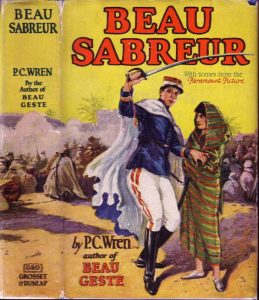
This eBook is made available at no cost and with very few
restrictions. These restrictions apply only if (1) you make
a change in the eBook (other than alteration for different
display devices), or (2) you are making commercial use of
the eBook. If either of these conditions applies, please
contact an FP administrator before proceeding.
This work is in the Canadian public domain, but may be under
copyright in some countries. If you live outside Canada, check your
country’s copyright laws. IF THE BOOK IS UNDER COPYRIGHT
IN YOUR COUNTRY, DO NOT DOWNLOAD OR REDISTRIBUTE THIS FILE.
Title: Beau Sabreur
Date of first publication: 1926
Author: Percival Christopher Wren
Date first posted: August 3, 2014
Date last updated: August 3, 2014
Faded Page eBook #20140807
This eBook was produced by: Marcia Brooks, ahains, Ron Tolkien
& the online Distributed Proofreaders Canada team at http://www.pgdpcanada.net
________________________________________________________________________
_BY THE SAME AUTHOR_
BEAU GESTE
THE WAGES OF VIRTUE
STEPSONS OF FRANCE
FATHER GREGORY
THE SNAKE AND THE SWORD
DEW AND MILDEW
THE YOUNG STAGERS
_All rights reserved_
BEAU SABREUR
BY PERCIVAL CHRISTOPHER WREN
“A man may escape from his enemies, or even from his
friends, but how shall a man escape from his own nature?”
LONDON
JOHN MURRAY, ALBEMARLE STREET, W.1.
FIRST EDITION JULY 1926
REPRINTED JULY 1926
REPRINTED AUGUST 1926
REPRINTED AUGUST 1926
REPRINTED AUGUST 1926
TO
“NOBBY,”
TRUE COMRADE,
TO WHOM THIS BOOK OWES MUCH.
NOTE
The Author would like to anticipate certain of the objections which
may be raised by some of the kindly critics and reviewers who gave so
friendly and encouraging a chorus of praise to _Beau Geste_, _The Wages
of Virtue_, and _The Stepsons of France_.
Certain of the events chronicled in these books were objected to, as
being impossible.
They were impossible.
The only defence that the Author can offer is that, although perfectly
impossible, they actually happened.
In reviewing _The Wages of Virtue_, for example, a very distinguished
literary critic remarked that the incident of a girl being found in the
French Foreign Legion was absurd, and merely added an impossibility to
a number of improbabilities.
The Author admitted the justice of the criticism, and then, as now, put
forth the same feeble defence that, although perfectly impossible, it
was the simple truth. He further offered to accompany the critic (at
the latter’s expense) to the merry town of Figuig in Northern Africa,
and there to show him the tomb-stone (with its official epitaph) of a
girl who served for many years, _in the Spahis, as a cavalry trooper_,
rose to the rank of Sergeant, and remained, until her death in battle,
quite unsuspected of being what she was–a European woman.
And in this book, nothing is set forth as having happened which has
not happened–including the adoption of two ex-Legionaries by an Arab
tribe, and their rising to Sheikdom and to such power that they were
signatories to a treaty with the Republic.
One of them, indeed, was conducted over a French troopship, and his
simple wonder at the marvels of the _Roumi_ was rather touching, and of
pleasing interest to all who witnessed it. . . .
The reader may rest assured that the deeds narrated, and the scenes and
personalities pictured, in this book, are not the vain outpourings of a
film-fed imagination, but the re-arrangement of actual happenings and
the assembling of real people who have actually lived, loved, fought
and suffered–and some of whom, indeed, live, love, fight and suffer to
this day.
Truth _is_ stranger than fiction.
CONTENTS




Reader notes
Loading reader notes…