This ebook is made available at no cost and with very few
restrictions. These restrictions apply only if (1) you make
a change in the ebook (other than alteration for different
display devices), or (2) you are making commercial use of
the ebook. If either of these conditions applies, please
check with an FP administrator before proceeding.
This work is in the Canadian public domain, but may be
under copyright in some countries. If you live outside Canada,
check your country’s copyright laws. IF THE BOOK IS UNDER
COPYRIGHT IN YOUR COUNTRY, DO NOT DOWNLOAD
OR REDISTRIBUTE THIS FILE.
Title: The Torch
Author: Bechdolt, Jack [John Ernest] (1884-1954)
Date of first publication: 1920
Edition used as base for this ebook:
Fantastic Novels, April 1951
[New York: New Publications, Inc.]
Date first posted: 19 January 2017
Date last updated: April 18, 2017
Faded Page ebook#20170462
This ebook was produced by Al Haines
PUBLISHER’S NOTE
Italics in the original printed edition are indicated _thus_.
As part of the conversion of the book to its new digital
format, we have made certain minor adjustments in its layout,
and have added a table of contents.
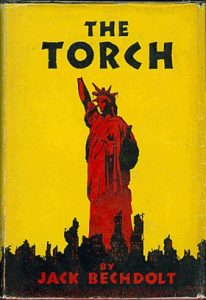
THE TORCH
By Jack Bechdolt
From the Earth’s dead yesterdays it shone, its flame a treason, its
message hope–while its last embattled champion fought the strange
inhuman civilization that had spawned him–for his birthright in the
stars!
Contents
I. The Road to Fame
II. Fortune Makes an Enemy
III. The Great Woman’s Isle
IV. Fortune gives his Promise
V. “The Torch will burn again!”
VI. The Black Morning
VII. The Undying Fire
VIII. “I Serve the Torch!”
IX. The Stage is Set
X. A New World is Born
PROLOGUE
In our own happy day it is difficult for us to realize conditions on
this continent during the Dark Ages, especially in those blackest years
early in the century two thousand. To fully appreciate the tragedy of
the American people one must realize that previous to this time, when
all the world groped through the gloom of savagery, there was a
civilization on this earth almost, if not fully, as far advanced as
that of this year 3010.
Recent archeological research has proved this beyond a doubt, and the
skeptical reader is referred to official reports of the excavations
among the ruins of cities along the Pacific coast, where, because all
life seems to have been extinguished instantly by the great
catastrophe, it has been possible to uncover almost intact the evidence
of a state of society that apparently lacked nothing of the material
advantages we enjoy to-day.
Modern science has identified the great catastrophe of the ancients
(authorities have definitely fixed the date between the years A.D. 1980
and 1989) as the visitation to the solar system of a sky wanderer of
the same nature as several of the greatest known comets, though
probably vastly larger and more powerful in its influence on
terrestrial life.
At the time of that visitation men had come to depend entirely on what
the ancients termed _electrical energy_. There is little doubt that
this _electricity_ of those days is the same energy of the spheres
which is the keystone of our complex society, though in that day it is
plain men knew absolutely nothing of its source or characteristics.
Humanity had harnessed a servant of which it was densely ignorant, and
upon that servant depended for transportation, communication, heat,
light, and health. The universal use of _electricity_ had supplanted
all earlier and clumsier machinery of society.
Knowing this, we can easily understand how the visit of the great comet
almost instantly paralyzed that simpler civilization and threw the
world into chaos.
Probably this one mechanical fact was the chief reason for the complete
breakdown of all society, though there are grounds for belief that
unsettled political conditions, long in ferment, played some part in
the catastrophe. And surely there is proof, even to-day, of the
terrible visitation of earth shakings and storms which, within a brief
space of time, reduced the proudest cities of that distant past.
The author of this tale has endeavored to present a truthful picture of
human life as it was in the saddest time of world history, basing his
descriptions on ancient manuscripts and the testimony of the latest
scientific investigation. We know it to have been a time of dense
ignorance and superstition. Learning, in the shape of the few written
records that survived the great catastrophe, was in the hands of a few,
who used it for their own selfish advantage.
The little communities were isolated, one from another. There was no
commerce nor means of communication save on foot or by frail,
water-borne vessel. The wild beasts of the great American jungles
rendered the first means almost out of the question, and ignorance of
modern marine construction limited the second to a narrow radius of
inland waters.
The miserable remnants of a great race huddled in the ruins of what had
once been proud cities, their life a perpetual struggle against nature
and their own kind; their society the most primitive state of absolute
monarchy; ignorant, superstitious and seemingly hopeless. Yet these
were our ancestors. In such a time were born such thinkers as Zorn the
Recluse, justly termed Father of Freedom, and Mary of the Isle, revered
to-day wherever freemen walk.
And in the ruin of the statue of the Great Woman, unseen by men, yet
guiding their lives, flamed The Torch, burning clear and free with a
fire immortal.




Reader notes
Loading reader notes…