This eBook is made available at no cost and with very few
restrictions. These restrictions apply only if (1) you make
a change in the eBook (other than alteration for different
display devices), or (2) you are making commercial use of
the eBook. If either of these conditions applies, please
check with an FP administrator before proceeding.
This work is in the Canadian public domain, but may be
under copyright in some countries. If you live outside Canada,
check your country’s copyright laws. IF THE BOOK IS UNDER
COPYRIGHT IN YOUR COUNTRY, DO NOT DOWNLOAD
OR REDISTRIBUTE THIS FILE.
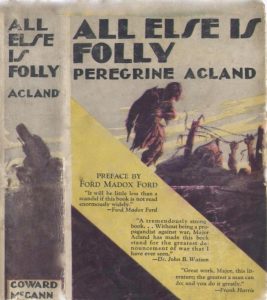
Title: All Else Is Folly. A Tale of War and Passion.
Author: Peregrine Palmer Acland (1891-1963)
Author [preface]: Ford Madox Ford (1873-1939)
Date of first publication: 1929
Date first posted: 1 March 2014
Date last updated: 29 March 2014
Faded Page eBook #20140346
This ebook was produced by Al Haines
All Else Is Folly
_A Tale of War and Passion_
BY
PEREGRINE ACLAND
WITH A NOTE BY WAY OF PREFACE
BY FORD MADOX FORD
MCCLELLAND & STEWART LTD.
PUBLISHERS – – – – TORONTO
COPYRIGHT, CANADA. 1929
BY MCCLELLAND & STEWART, LTD.
Printed in Canada.
To M. L. A.
Even if there were not a
thousand other reasons for doing so,
I would dedicate this book to
you because your criticisms have
been my chief help in writing it.
P. A.
“It is more passion and ever more that we need if we are to undo the
work of Hate, if we are to add to the gaiety and splendour of life, to
the sum of human achievement, to the aspiration of human
ecstasy.”–HAVELOCK ELLIS.
“You I advise not to work but to fight. You I advise not to peace but
to victory. Let your work be a fight. Let your peace be a victory….
“Man shall be trained for war, and woman for the recreation of the
warrior; all else is folly.”–NIETZSCHE: “Thus Spake Zarathustra.”
A NOTE BY WAY OF PREFACE
I do hope that, quite apart from the esthetico-literary considerations
that are my usual _tic_ and that as a rule prevent the British reader
from paying any attention to books that I urge on his attention so that
I practically never, whatever may be the case with the United States,
write any prefaces for the English editions of books…. I do hope
then that a very large public may be found for Major Acland’s book on
both sides of the Atlantic.
For it is the convincing, mournful and unrelieved account of a simple
soul’s sufferings in the late War.
And I believe that those sufferings have never been sufficiently
brought home to the public as a whole and that is why the late War has
not aroused half the horror of war as a whole that it should have
aroused…. For the defect of all novel-writing is that, as a rule,
the novelist–heaven help him!–must needs select unusual,
hypersensitized souls to endure any vicissitudes that he is pleased to
make them endure and that makes him lose half the game with the normal
reader. I remember very well–for I am not pleading not
guilty!–thinking to myself when about half-way through a novel about
the late War: “Well, my central character is altogether such a queer,
unusual fellow that I do not see how any one is going much to
sympathize with him in his misfortunes….” Thoughts to that
effect…. And pretty nearly as much can be said of the books of most
of my Anglo-Saxon or Latin colleagues, whilst, on the whole, writers
from the Central or Slavic Empires emphasize the note by dwelling on
the sufferings of mournful but unusual peasants. The result is that
the normal man says: “These are not normal people!” and continues to
comfort himself either by imagining that the late struggle was for
those engaged in it a perpetual picnic varied with sexual jamborees or
by ignoring the matter altogether.
That is a misfortune. But it is a misfortune that Major Acland’s book
may do a great deal to mitigate. For his central character is about as
normal in temperament and circumstances as it is possible to be. He is
neither high nor low in station; neither hypersensitized nor callous;
neither Adonis nor Caliban; neither illiterate nor of the
intelligentsia; neither a brute nor a poet, though like so many of us
he writes an occasional very mediocre sonnet which fails to cause the
lady of his devotion to fall for him. And he is no coward and no
hero–though he endures without much squealing sufferings out of which
he, like the rest of us, would very gladly have got–wangled, used to
be the technical word! … “If one could only,” one used to say
innumerable times, “wangle a staff-job.” Or a Home Job. Or a
week-end’s leave in Paris…. Or even a Blighty!
So Major Acland’s Falcon would eventually very gladly–but like all of
us, how vainly!–have applied for a Staff Job; have been sent home to
Canada to train details–with young woman for the use of officer, one,
complete…. Then when he is worn and wearied out he is put into the
most hellish scrap of all. And gets his Blighty….
But with his bashed in face and mangled limbs his young woman who also
is wearied out turns him down and back he goes to Canada–and
presumably carries on.
Nevertheless, at the skirl of the pipes: “War-lust again surged through
him.” As it does for us all. And that really is the lesson of the
book–the lesson that our publics and lawmakers would do well to
ponder. “Yet now,” Major Acland concludes, “with the skirling of the
pipes in his ears, he would have signed away his liberty, his life, for
another war. It wouldn’t have mattered much what the war was about….
Not when this vast hall rocked with the tread of two thousand feet and
his hot blood leaped to the pipes….”
I have, myself, by coincidence, felt much the same in Montreal when
Major Acland’s kilted regiment went by on the street. For the matter
of that I felt much the same on the yesterday of this writing when the
165th regiment of United States Infantry went past the Public Library
on Fifth Avenue with the equivalent for the King’s Colors and the other
colors flying and the band playing for St. Patrick’s day in the
morning…. Of course _not quite_ the same feeling….
Towards the end Major Acland’s book works up to a very great–a very
fine–poignancy of feeling. I imagine that, as a relatively senior
officer but a quite junior writer, much as we did during the War, he
picked up knowledge of how to handle things as he went along. But I
don’t of course know. It is, I mean, difficult to say whether the
relatively jejune effect of the rendering of English Country house life
and women is caused just by timidity of handling or whether it is a
masterly _compte rendu_ of how a young Colonial (Pardon the word,
Major, but there is no other adjective…. _You can’t_ write
Dominional) footslogging, second loot with bare and hairy knees would
feel on introduction to a rather vanished Smart Set…. In any case
the effect is the same and the information is very valuable.
Major Acland’s is, I imagine, the first really authentic work of
imaginative writing dealing with the War to come out of one of the
great British Dominions and if I were any sort of publicist I should
make a great deal out of that. But I am not, so I don’t.
Nevertheless, it seems to me that the war of the future, if there is to
be one, will pivot round the great British Dominions and, whether to
our own country or to individuals desirous to be responsible for
turning lately allied nations into those Enemy to our own, ALL ELSE is
FOLLY should present a great deal of food for thought–and for
misgiving. For it is a work that is a singularly reliable
subjectivization of that matter.
In it you see, really wonderfully rendered, the admirable Canadians
going through their jobs, with stoicism, without apparent enthusiasm,
with orderliness, discipline–and with what endurance! I saw a good
deal of the Canadians in France and liked them really more than any
other troops, my own battalion naturally excepted. And I am really in
a position to say that Major Acland’s rendering is by no means
laudatorily colored….
And how admirably it is all done…. When I read of the marching and
fighting towards the end of the book, I feel on my skin the keen air of
the early mornings standing to, I have in my mouth the dusky tastes, in
my eyes the dusky landscapes, in my ears the sounds that were silences
interrupted by clickings of metal on metal that at any moment might
rise to the infernal clamor of all Armageddon…. Yes, indeed, one
lives it all again, with the fear, and the nausea … and the surprised
relief to find oneself still alive. I wish I could have done it as
well myself: envy, you see, will come creeping in. But since I
couldn’t, the next best thing seems to me to be to say that it will be
little less than a scandal if the book is not read enormously widely.
And that is the truth.
FORD MADOX FORD.
AUTHOR’S NOTE: _ALL ELSE IS FOLLY was first written nearly two
years ago. It has been rewritten several times since. Even after
Mr. Ford wrote his generous preface, the entire book was again
revised, several considerable parts of it were completely
rewritten, and some important, although brief, additions were
made._
PEREGRINE ACLAND
New York City
October 23rd, 1929.




Reader notes
Loading reader notes…