* A Distributed Proofreaders Canada eBook *
This eBook is made available at no cost and with very few
restrictions. These restrictions apply only if (1) you make
a change in the eBook (other than alteration for different
display devices), or (2) you are making commercial use of
the eBook. If either of these conditions applies, please
contact a https://www.fadedpage.com administrator before proceeding.
Thousands more FREE eBooks are available at https://www.fadedpage.com.
This work is in the Canadian public domain, but may be under
copyright in some countries. If you live outside Canada, check your
country’s copyright laws. IF THE BOOK IS UNDER COPYRIGHT
IN YOUR COUNTRY, DO NOT DOWNLOAD OR REDISTRIBUTE THIS FILE.
Title: Strangers May Kiss
Date of first publication: 1930
Author: Katherine Ursula Towle (as Ursula Parrott) (1899-1957)
Date first posted: Nov. 30, 2022
Date last updated: Nov. 30, 2022
Faded Page eBook #20221159
This eBook was produced by: Al Haines, Krista Zaleski
& the online Distributed Proofreaders Canada team at https://www.pgdpcanada.net
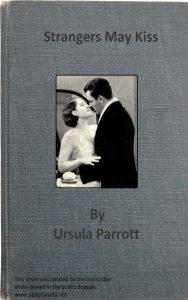
[Illustration:
_A Fox Movietone Production._ _Strangers May Kiss._
A MAN CAN LOVE AND FORGET–BUT A WOMAN LOVES ONLY ONCE.]
[Illustration]
Strangers May Kiss
URSULA PARROTT
[Illustration]
NEW YORK
JONATHAN CAPE & HARRISON SMITH
[Illustration]
COPYRIGHT, 1930, BY
JONATHAN CAPE AND
HARRISON SMITH, INC.
FIRST PUBLISHED, 1930
SECOND PRINTING JULY, 1930
(_Before Publication_)
THIRD PRINTING AUGUST, 1930
FOURTH PRINTING DECEMBER, 1930
PRINTED IN THE UNITED STATES OF AMERICA
TO
HUGH O’CONNOR
CONTENTS
PARADE 1
TOMORROW 23
TODAY 121
YESTERDAY 319
PARADE
On a Spring afternoon in 1919 the New England Division–newly home
from the War–paraded through the streets of Boston. At the end of the
largest adventure that life would bring to most of them, the young
men marched exuberantly–bathed in the cool fading sunlight of late
afternoon, and in the not yet faded consciousness of valour. All their
tomorrows had been given back, so recently that they had not yet begun
to be dubious of the value of the gift.
From the long simple hazards of war–they were marching toward civilian
clothes and individuality, toward small successes and inconsequential
failures–in general, toward obscurity. Some were to find their chief
pleasure thereafter, amid the unending complications of peace, in
marching in Memorial Day parades.
They marched well; and the watchers who were growing up to become the
post-war generation stood six deep on the sidewalks, or sat in the
rickety wooden stands which had served watchers at suffrage parades
before the War, and would serve watchers at St. Patrick’s Day parades
long after it. Some of the watchers cheered this day. Some sang. Only a
few wept for certain young men who would never again march through the
streets of Boston.
For an afternoon, in a world newly saved for Democracy, marchers and
watchers together savoured the imminence of the millennium, heralded by
bands playing “Good-bye France, Hello Broadway”–“There Are Smiles That
Make Me Ha-a-a-py”–“Over There, Over There”–“Beautiful Ka-a-a-a-tie
”–“Allons, enfants de la patrie.” . . .
* * * * *
In the front row of one of the most desirable grandstands a relatively
young man and a very young girl were devoting much more attention to
each other than to the parade. The man was ignoring it as completely
as the noise of the bands permitted, for he had seen so many more
parades than decorative young women in the past five years. The
girl, at seventeen, had just emerged from the adolescent scrawniness
that succeeded the stage when she was a dumpy child, and she had
seen few parades; but she had seen even fewer men; so she was having
difficulties.
She was a conscientious young person, and she felt that she should not
miss any of the look or stir of this parade. She would be expected
to tell her grandchildren about it. Yet a man–not merely a Harvard
sophomore–but a man in his thirties, who was at the same time
Handsome, a War Correspondent who became a Major, and a Hero, was a
phenomenon in the life of a Wellesley freshman much rarer even than
such a parade. Actually it was a phenomenon utterly . . . unique. She
wished she knew which of his beautiful decorations stood for what. She
felt it would seem _young_ to ask.
Torn between her duty to posterity and her instinct to make the most of
an opportunity that might not return in years, she sat in a state of
pink-cheeked embarrassment that seemed to her ridiculous, and, to the
man beside her, delectable.
To entertain her, he told her of things he had seen. She hoped she
chose the proper intervals to say, “Oh, how Tremendously Exciting!”
The conversation was interrupted by the passing of Boston’s favourite
colonel. She found it impossible to begin again. They were silent for a
time.
Looking down past the hat that came approximately to the level of his
shoulder, he thought: “I had forgotten the American female, young,
could blush so entertainingly. She will be a most beautiful woman
in three or four years. . . . In three or four years, I shall be
thirty-five. . . .” That depressed him, so he returned to consideration
of the girl.
“She might look a little unfinished beside a Continental woman, but
that amazing freshness warms a man’s heart. If she weren’t such a
juvenile, I should make love to her . . . try to sleep with her. No
doubt she would be magnificent. . . . In due course, she will sleep
with some young Boston banker, I suppose, after the usual ceremonies in
Trinity Church; and take her children walking on the Esplanade. . . .
Curious, how she stirs a desire for the women of one’s own country.”
Then, because she seemed absorbed in the parade, the man thought for
a while of certain women not of his own country but likely to be more
permanently in his life than this child, whom he had met at luncheon
and had invited to share his seats for the parade because she looked so
young and ardent.
There was for instance his wife, with whom he shared an apartment
in Paris when his headquarters were there; and with whom he had once
shared high felicity, about the time this child beside him was nine
years old. His wife, Marjorie, was a woman of poise and intelligence,
a cool-eyed, graceful Englishwoman with a bitter pride, to whom he was
grateful because she had convinced him, for all time, that he was not a
man who could make a successful marriage. He still found her charming,
he reflected, though he would no more think of sharing her bed nowadays
than he would think of divorcing her. He had been unfaithful long
before she was; his work took him on such long absences, and his
temperament was not faithful anyhow. The emphasis women laid on that
always seemed to him altogether disproportionate.




Reader notes
Loading reader notes…