* A Distributed Proofreaders Canada eBook *
This eBook is made available at no cost and with very few
restrictions. These restrictions apply only if (1) you make
a change in the eBook (other than alteration for different
display devices), or (2) you are making commercial use of
the eBook. If either of these conditions applies, please
contact an FP administrator before proceeding.
This work is in the Canadian public domain, but may be under
copyright in some countries. If you live outside Canada, check your
country’s copyright laws. IF THE BOOK IS UNDER COPYRIGHT
IN YOUR COUNTRY, DO NOT DOWNLOAD OR REDISTRIBUTE THIS FILE.
Title: The Pearl Lagoon
Date of first publication: 1924
Author: Charles Bernard Nordhoff
Date first posted: Oct. 27, 2013
Date last updated: Oct. 27, 2013
Faded Page eBook #20110412
This eBook was produced by: David T. Jones, Al Haines, Ross Cooling
& the online Distributed Proofreaders Canada team at http://www.pgdpcanada.net
_E MAO! A SHARK!_
“I leaned over with the rest, watching with acute suspense. . . . No–he
had seen Ofai and was turning back toward the deep crevice in which the
diver had taken refuge. . . .
“An exclamation of horror went up from the men. . . .
“Thirty seconds passed. My uncle had reached the limit of his endurance.
He spoke to Fatu sharply: “‘Your goggles! That knife! The other
weight!'”
Priceless pearls lay beneath the lagoon’s blue surface. A treasure only
for the brave.
About the Author
Charles Bernard Nordhoff broke into print at the age of 16 with an
article for an ornithological journal called the _Auk_.
“If I had my life to live over again, I should do the necessary
groundwork and become a professional anthropologist. All my life I have
loved shooting, fishing, sailing or traveling through the wild country
alone or with a single companion.”
Love of far places took Nordhoff and his friend James Norman Hall to
Tahiti soon after they finished writing the history of the famous
Lafayette Flying Corps of World War I. Nordhoff, an early volunteer, won
the Croix de Guerre for his exploits.
In Tahiti Nordhoff and Hall came upon one of the famous sea stories of
all time–the story of cruel but courageous Captain Bligh. Out of this
research came _Mutiny on the Bounty_, _Men Against the Sea_, and
_Pitcairn’s Island_.
Nordhoff married Pepe Teara. They had six children–four daughters and
two sons. He died in 1947 at the age of 60.
Into _The Pearl Lagoon_ Charles Nordhoff wove his love and knowledge of
the South Pacific islands and their people. It is his only story written
through the eyes of young people. Ever since its publication _The Pearl
Lagoon_ has won an ever-widening enthusiastic audience. The Teen Age
Book Club makes this favorite available in paperback for the first
time.
By CHARLES NORDHOFF
The Pearl Lagoon
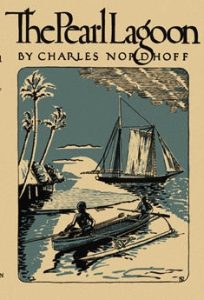
_Cover illustration by Charles Beck_
A TAB BOOK
Published and distributed by TAB Books, Inc., an affiliate of
Scholastic Magazines, 33 West 42nd Street, New York 36, N. Y.
To
WALTER AND SARAH C. W. NORDHOFF
Dear Parents and Understanding Friends
Whose Grandchildren, I Hope, Will
One Day Read This Book
* * * * *
Copyright 1924 by The Atlantic Monthly Press
This unabridged edition is reprinted by arrangement with Little, Brown &
Company, by whom the work is published in association with The Atlantic
Monthly Press. Published in 1955 by Teen Age Books, Inc. for
distribution through the Teen Age Book Club.
Printing History
1st printing January, 1956
2nd printing April, 1957
3rd printing January, 1960
Printed in the U.S.A.
CONTENTS
_CHAPTER_ _PAGE_
1. The Coming of the Schooner 1
2. The Pearls of Iriatai 13
3. Aboard the Tara 30
4. At Faatemu 46
5. Iriatai 59
6. The End of the Shark 74
7. South Sea Fishermen 86
8. I Turn Pearl Diver 95
9. The Cave of the Shark God 114
10. The Cholita Comes to Iriatai 121
11. Piracy 141
12. “Boarders!” 152
13. Tahiti 168
Other Books by Charles Nordhoff
THE FLEDGLING
PICARO
(with James Norman Hall)
THE LAFAYETTE FLYING CORPS
FALCONS OF FRANCE
MUTINY ON THE BOUNTY[1]
MEN AGAINST THE SEA[1]
PITCAIRN’S ISLAND
THE HURRICANE
[Footnote 1: _TAB Club Selections_]
1. The Coming of the Schooner
We lived on the coast of California, on the Spanish grant my grandfather
had purchased from the mission which still stands, deserted and
crumbling, in the Santa Brigida Valley. Our house, built long before the
Civil War, overlooked the lower end of the valley, from a knoll above
the salt marshes at the river mouth. The house was built in the form of
a hollow square, surrounding a paved court. The walls were of
adobe,–sun-dried bricks of clay, mixed with a little straw,–four feet
thick, and pierced by small grated windows, designed for loopholes more
than for the admittance of light and air. The beams and rafters were of
roughhewn pine, carried down from the mountains by the Santa Brigida
Indians, a tribe long since extinct, and the same patient workers had
moulded and baked the old red tiles of the roof.
My father and my uncle Harry Selden had been brought up to the
half-Spanish life of old California. For ten miles along the coast and
six miles inland the land was theirs, and in those days three thousand
head of cattle, bearing my grandfather’s brand, grazed on the mesas and
filed down in long lines to drink. When the brothers were young, the
grizzly still lingered around the hills, tracks of deer and mountain
lion were everywhere, the quail trotted in thousands along the river
bottom, and in the winter months the plains along the seacoast were
clamorous with flocks of wild geese, feeding on the rich grass. But
times were changing, and little by little, civilization was creeping in.
A church and a schoolhouse were built in the township north of us; taxes
were raised; and finally a party of surveyors appeared, running a line
for the new railway. My grandfather abhorred the idea of a railway
passing through his land; he made a bitter fight and would not give in
till his own lawyer showed him that if he refused to accept what was
offered for the right of way, the law would force him to do so for the
public good. He died a short time after the trains began to run.




Reader notes
Loading reader notes…