=* A Distributed Proofreaders Canada eBook *=
This eBook is made available at no cost and with very few restrictions.
These restrictions apply only if (1) you make a change in the eBook
(other than alteration for different display devices), or (2) you are
making commercial use of the eBook. If either of these conditions
applies, please contact a https://www.fadedpage.com administrator before
proceeding. Thousands more FREE eBooks are available at
https://www.fadedpage.com.
This work is in the Canadian public domain, but may be under copyright
in some countries. If you live outside Canada, check your country’s
copyright laws. IF THE BOOK IS UNDER COPYRIGHT IN YOUR COUNTRY, DO NOT
DOWNLOAD OR REDISTRIBUTE THIS FILE.
_Title:_ Tarzan and the Lost Empire
_Date of first publication:_ 1928
_Author:_ Edgar Rice Burroughs (1875-1950)
_Date first posted:_ July 2, 2016
_Date last updated:_ Oct. 30, 2021
Faded Page eBook #20160704
This eBook was produced by: Al Haines, Cindy Beyer & the online
Distributed Proofreaders Canada team at http://www.pgdpcanada.net
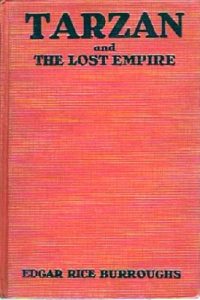
Tarzan and the
Lost Empire
EDGAR RICE BURROUGHS
Copyright © 1928, 1929 by Consolidated Magazines Corporation
Copyright © 1929 by Edgar Rice Burroughs, Inc.
CHAPTER ONE
NKIMA DANCED EXCITEDLY upon the naked, brown shoulder of his master. He
chattered and scolded, now looking up inquiringly into Tarzan’s face and
then off into the jungle.
“Something is coming, Bwana,” said Muviro, sub-chief of the Waziri.
“Nkima has heard it.”
“And Tarzan,” said the ape-man.
“The big Bwana’s ears are as keen as the ears of Bara the antelope,”
said Muviro.
“Had they not been, Tarzan would not be here today,” replied the
ape-man, with a smile. “He would not have grown to manhood had not Kala,
his mother, taught him to use all of the senses that Mulungu gave him.”
“What comes?” asked Muviro.
“A party of men,” replied Tarzan.
“Perhaps they are not friendly,” suggested the black. “Shall I warn the
warriors?”
Tarzan glanced about the little camp where a score of his black fighting
men were busy preparing their evening meal and saw that, as was the
custom of the Waziri, their weapons were in order and at hand.
“No,” he said. “It will, I believe, be unnecessary, as these people who
are approaching do not come stealthily as enemies would, nor are their
numbers so great as to cause us any apprehension.”
But Nkima, a born pessimist, expected only the worst, and as the
approaching party came nearer his excitement increased. He leaped from
Tarzan’s shoulder to the ground, jumped up and down several times and
then springing back to Tarzan’s side, seized his arm and attempted to
drag him to his feet.
“Run, run!” he cried, in the language of the apes. “Strange Gomangani
are coming. They will kill little Nkima.”
“Do not be afraid, Nkima,” said the ape-man. “Tarzan and Muviro will not
let the strangers hurt you.”
“I smell a strange Tarmangani,” chattered Nkima. “There is a Tarmangani
with them. The Tarmangani are worse than the Gomangani. They come with
thundersticks and kill little Nkima and all his brothers and sisters.
They kill the Mangani. They kill the Gomangani. They kill everything
with their thundersticks. Nkima not like the Tarmangani. Nkima is
afraid.”
To Nkima, as to the other denizens of the jungle, Tarzan was no
Tarmangani, no white man. He was of the jungle. He was one of them, and
if they thought of him as being anything other than just Tarzan it was
as Mangani, a great ape, that they classified him.
The advance of the strangers was now plainly audible to everyone in the
camp. The Waziri warriors glanced into the jungle in the direction from
which the sounds were coming and then back to Tarzan and Muviro, but
when they saw that their leaders were not concerned they went quietly on
with their cooking.
A tall, black warrior was the first of the party to come within sight of
the camp. When he saw the Waziri he halted and an instant later a
bearded white man stopped beside him.
For an instant the white man surveyed the camp and then he came forward,
making the sign of peace. Out of the jungle a dozen or more blacks
followed him. Most of them were porters, there being but three or four
rifles in evidence.
Tarzan and the Waziri realized at once that it was a small and harmless
party, and even Nkima, who had retreated to the safety of a nearby tree,
showed his contempt by scampering fearlessly back to climb to the
shoulder of his master.
“Doctor von Harben!” exclaimed Tarzan, as the bearded stranger
approached. “I scarcely recognized you at first.”
“God has been kind to me, Tarzan of the Apes,” said von Harben,
extending his hand. “I was on my way to see you and I have found you a
full two days’ march sooner than I expected.”
“We are after a cattle-killer,” explained Tarzan. “He has come into our
kraal several nights of late and killed some of our best cattle, but he
is very cunning; I think he must be an old lion to outwit Tarzan for so
long.
“But what brings you into Tarzan’s country, Doctor? I hope it is only a
neighbourly visit and that no trouble has come to my good friend, though
your appearance belies my hope.”
“I, too, wish that it were nothing more than a friendly call,” said von
Harben. “But as a matter of fact I am here to seek your help because I
am in trouble—very serious trouble, I fear.”
“Do not tell me that the Arabs have come down again to take slaves or to
steal ivory, or is it that the leopard men are waylaying your people
upon the jungle trails at night?”
“No, it is neither the one nor the other. I have come to see you upon a
more personal matter. It is about my son, Erich. You have never met
him.”
“No,” said Tarzan; “but you are tired and hungry. Let your men make camp
here. My evening meal is ready; while you and I eat you shall tell me
how Tarzan may serve you.”
As the Waziri, at Tarzan’s command, assisted von Harben’s blacks in
making their camp, the doctor and the ape-man sat cross-legged upon the
ground and ate the rough fare that Tarzan’s Waziri cook had prepared.
Tarzan saw that his guest’s mind was filled with the trouble that had
brought him in search of the ape-man, and so he did not wait until they
had finished the meal to reopen the subject, but urged von Harben to
continue his story at once.




Reader notes
Loading reader notes…