This ebook is made available at no cost and with very few restrictions.
These restrictions apply only if (1) you make a change in the ebook
(other than alteration for different display devices), or (2) you are
making commercial use of the ebook. If either of these conditions
applies, please contact a FP administrator before proceeding.
This work is in the Canadian public domain, but may be under copyright
in some countries. If you live outside Canada, check your country’s
copyright laws. IF THE BOOK IS UNDER COPYRIGHT IN YOUR COUNTRY, DO NOT
DOWNLOAD OR REDISTRIBUTE THIS FILE.
_Title:_ A Lantern in her Hand
_Date of first publication:_ 1928
_Author:_ Beth Streeter Aldrich (1881-1954)
_Date first posted:_ June 14, 2015
_Date last updated:_ June 14, 2015
Faded Page eBook #20150638
This ebook was produced by: David T. Jones, Al Haines. Alex White & the
online Distributed Proofreaders Canada team at http://www.pgdpcanada.net
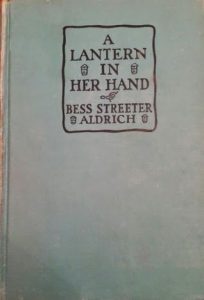
A LANTERN
IN HER HAND
BESS STREETER ALDRICH
* * * * *
_Because the road was steep and long,_
_And through a dark and lonely land,_
_God set upon my lips a song_
_And put a lantern in my hand._
JOYCE KILMER
* * * * *
G R O S S E T & D U N L A P
Publishers||New York
_By arrangement with D. Appleton-Century Company_
* * * * *
C O P Y R I G H T — 1 9 2 8 — B Y
D . A P P L E T O N & C O M P A N Y
* * * * *
_All rights reserved. This book, or parts_
_thereof, must not be reproduced in any_
_form without permission of the publishers._
PRINTED IN THE UNITED STATES OF AMERICA
A Lantern in Her Hand
INTRODUCTION
Cedartown sits beside a great highway which was once a buffalo trail. If
you start in one direction on the highway—and travel far enough—you
will come to the effete east. If you start in the opposite
direction—and travel a few hundred miles farther—you will come to the
distinctive west. Cedartown is neither effete nor distinctive, nor is it
even particularly pleasing to the passing tourist. It is beautiful only
in the eyes of those who live here and in the memories of the
Nebraska-born whose dwelling in far places has given them moments of
homesickness for the low rolling hills, the swell and dip of the
ripening wheat, the fields of sinuously waving corn and the elusively
fragrant odor of alfalfa.
There are weeks when drifting snow and sullen sleet hold the Cedartown
community in their bitter grasp. There are times when hot winds come out
of the southwest and parch it with their feverish breath. There are
periods of monotonous drouth and periods of dreary rain; but between
these onslaughts there are days so perfect, so filled with clover odors
and the rich, pungent smell of newly turned loam, so sumac-laden and
apple-burdened, that to the prairie-born there are no others as lovely
by mountain or lake or sea.
The paved streets of Cedartown lie primly parallel over the obliterated
tracks of the buffalo. The substantial buildings of Cedartown stand
smartly over the dead ashes of Indian campfires. There are very few
people left now in the community who have seen the transition,—who have
witnessed the westward trek of the last buffalo, the flicker of the last
burnt-out ember.
Old Abbie Deal was one of these.
Just outside the corporate limits of Cedartown stands the old Deal home.
It was once a farm-house, but the acreage around it has been sold, and
Cedartown has grown out to meet it, so that a newcomer could not know
where the town ceased and the country began.
The house stands well back from the road in a big yard with a long
double row of cedars connecting the formal parlor entrance and the small
front gate. However, in the days when the Deals lived there, scarcely
any one used the little gate, or walked up the grassy path between the
cedars. All comers chose to enter by the wide carriage-gate standing
hospitably open and beckoning a welcome to the lane road which runs past
a row of Lombardy poplars to the sitting-room porch.
The house itself is without distinction. There were no architects in the
community when the first of its rooms were built. “We’ll have the
living-room there and the kitchen here,” one told old Asy Drumm. And old
Asy, with few comments and much tobacco-chewing, placed the living-room
there and the kitchen here. The result was weatherproof, sturdy and
artless. When the country was new, homes, like dresses, were constructed
more for wearing qualities than beauty.
Twice, onto the first wing-and-ell, old Asy, a little more glum and
tobacco-stained, added a room, until the house had attained its present
form. That form, now, is not unlike an aeroplane which has settled down
between the cedars at the front and the cottonwood wind-break in the
rear. The parlor, protruding toward the road, might contain the engine.
The sitting-room to the left and a bedroom to the right seem the wings,
while the dining-room, kitchen, and a summer kitchen beyond, trail out
like the long tail of the thing. If one’s imagination is keen he can
even fancy that the fan-shaped colored-glass window in the parlor may
some day begin to whirl, propeller-like, and the whole house rise up
over the cedars.
The interior of the house, during Abbie Deal’s lifetime, was a
combination of old-fashioned things which she had accumulated through
the years, and modern new ones which the grown children had given her. A
dull-finished, beautifully-proportioned radio cabinet stood opposite a
homemade, rudely painted what-not. A kitchen table, with a little
declivity in one corner, in which old Doc Matthews had rolled pills in
Civil War times, stood near a white enameled case which was the last
word in refrigeration. A little crude oil-painting of a prairie sunset,
which Abbie Deal had done in the ’seventies, hung across the room from a
really exquisite study of the same subject, which a daughter, Mrs.
Frederick Hamilton Baker, had done forty years later.
Abbie Deal kept everything that had ever come into the house. Every
nail, every button, every string, was carefully hoarded. “This would
make a strong bottom for one of the kitchen chairs some day,” old Abbie
Deal would say, when in truth the bottom of the chair was as strong as
its legs. Or, “Save those stubs of candles from the Christmas tree. I
can melt them and run them into one big one.” The characteristic was a
hang-over from the lean and frugal days when the country was new, when
every tiny thing had its use. As a consequence, there was in the house
the flotsam of all the years.
One of the daughters, Mrs. Harrison Scannell Rhodes, on her annual visit
out from Chicago, protested once: “Mother, if the house only represented
some one _period_! But it’s such a jumbled combination of things.
They’re not antique. They’re just _old_.”
“And why should it?” Old lady Deal flared up a little. “_I’m_ no one
period. I’ve lived with spinning-wheels and telephones . . . with
tallow-dips and electric lights. _I’m_ not antique. I’m just _old_. It
represents _me_, doesn’t it?”
You will infer from the retort that old Abbie Deal was a strong
personality. And you will be quite right. The fact that she lived there
in the old home until her eightieth year, over the protests of children
and grandchildren, attested to that. At the time she was seventy, they
began trying to pry her away from “The Cedars.” They talked over various
plans for her—that she should go to Omaha to live with Mack,—to
Lincoln to live with Margaret,—that she should have rooms at John’s
right there in Cedartown,—that Grace should give up her teaching in
Wesleyan University temporarily and stay at home. When they had quite
definitely decided on the Lincoln home with Margaret, old Abbie Deal
spoke. “I will do nothing of the kind,” she said with finality. “I am
going to stay right here. And kindly let me alone. Because a woman is
old, has she no rights?”
After that they did not press the matter. They “let her alone,” but they
drove in frequently, for only the Chicago daughter lived far away.
Sometimes, on Sundays, the lane road contained a half dozen high-powered
cars parked there through the dinner hour and the afternoon. But not one
son or daughter could ever become reconciled to the idea of driving away
and leaving her there.
“When I think of fire . . .” one of them would say.
“Or of her getting sick in the night . . .”
“Or falling . . . and no one to help her . . .”
“Or any one of a dozen things . . .”
“Yes . . . something will happen to Mother some day.”
And they were quite right. Something happened to Mother. Last July on a
late afternoon, while suppers cooked and children of the north end of
town played “Run, Sheep, Run,” in her yard, old lady Deal died. A
neighbor woman found her lying across the foot of the bed, fully
dressed, while the slice of meat which she had been cooking, burned to a
crisp.
Of the five middle-aged children, seven grandchildren and three
great-grandchildren, not one was with her. They all came hastily in
response to the messages. Within two hours’ time, a shining limousine,
two big sedans, and a roadster all stood in the lane road. For the first
time, when the cars turned into the driveway by the Lombardy poplars, no
little old white-haired woman with bright brown eyes, had come hurrying
out to give cheery greeting. That queer, solemn hush of death hung over
the whole place. It was in the quivering droop of the cottonwoods,—in
the deepening of the prairie twilight,—in the silence of the
star-filled summer sky.
They all gathered in the parlor with its modern radio and its
old-fashioned what-not, its elaborate new floor-lamp and its crude
oil-painting. All of the children and several of the grandchildren were
there. Mackenzie Deal, the Omaha banker, was there. John Deal, the
Cedartown attorney and state legislator, was there. Mrs. Harrison
Scannell Rhodes of Chicago, who had been visiting in Omaha, was there.
Mrs. Frederick Hamilton Baker, of Lincoln, and Miss Grace Deal, of
Wesleyan University, were there. They were people of poise, men and
women not given to hysterical demonstration, but at the first gathering
they all broke down. For a brief quarter of an hour there in the old
parlor with its familiar objects, they let their grief have sway. For a
little while there in the farm-home of their youth, they were but
children whose mother had left them lonely when night was coming on.
When they had pulled themselves together, their greatest grief seemed to
be that she died alone. In deepest remorse they blamed themselves.
Standing there together in common sorrow, they said the same thing over
and over to each other:
“Didn’t she seem as well as ever to you last week?”
“I’ll never forgive myself that I played bridge all afternoon.”
“Do you suppose she suffered much?”
“Or called for us?”
“Isn’t it _dreadful_? Poor Mother! So many of us . . . and not one of us
here just when she needed us . . . and after all she’s done for us.”
Only one,—Laura Deal,—a twelve-year-old granddaughter, turned away
from the window where she had been looking down the long double row of
cedars, and said in a clear, steady voice: “_I_ don’t think it was so
dreadful. I think it was kind of nice. Maybe she didn’t miss you.” She
looked slowly around the circle of her elders. “When you stop to think
about it, maybe she didn’t miss you _at all_. One time Grandma told me
she was the very happiest when she was living over all her memories.
Maybe . . .” She hesitated, a little shy at expressing the thought in
her heart, “Maybe she was doing that . . . _then_.”
* * * * *
This is the story of the old lady who died while the meat burned and the
children played “Run, Sheep, Run,” across her yard.




Reader notes
Loading reader notes…