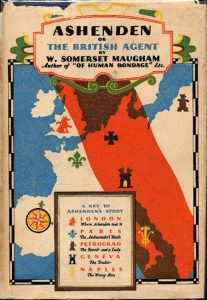
* A Distributed Proofreaders Canada Ebook *
This ebook is made available at no cost and with very few
restrictions. These restrictions apply only if (1) you make
a change in the ebook (other than alteration for different
display devices), or (2) you are making commercial use of
the ebook. If either of these conditions applies, please
check with an FP administrator before proceeding.
This work is in the Canadian public domain, but may be
under copyright in some countries. If you live outside Canada,
check your country’s copyright laws. IF THE BOOK IS UNDER
COPYRIGHT IN YOUR COUNTRY, DO NOT DOWNLOAD
OR REDISTRIBUTE THIS FILE.
Title: Ashenden: or, The British Agent
Author: Maugham, W. Somerset [William Somerset] (1874-1965)
Date of first publication: 1928
Edition used as base for this ebook:
London: Heinemann, 1961
Date first posted: 6 February 2016
Date last updated: May 18, 2016
Faded Page ebook#20160522
This ebook was produced by Al Haines and Mark Akrigg
PUBLISHER’S NOTE
Italics in the original printed edition are indicated _thus_.
As part of the conversion of the book to its new digital
format, we have made certain minor adjustments in its layout.
THE COLLECTED EDITION OF
THE WORKS OF W. SOMERSET MAUGHAM
W. SOMERSET MAUGHAM
ASHENDEN
OR THE BRITISH AGENT
HEINEMANN
LONDON MELBOURNE TORONTO
FIRST PUBLISHED 1928
REPRINTED 1928 (twice), 1929 (twice),
1931, 1934, 1938, 1948 (twice),
1950, 1951 (twice), 1956, 1961
PRINTED IN GREAT BRITAIN
BY THE WINDMILL PRESS LTD
KINGSWOOD, SURREY
PREFACE
This book is founded on my experiences in the Intelligence Department
during the war, but rearranged for the purposes of fiction. Fact is a
poor story-teller. It starts a story at haphazard, generally long
before the beginning, rambles on inconsequently and tails off, leaving
loose ends hanging about, without a conclusion. It works up to an
interesting situation, and then leaves it in the air to follow an issue
that has nothing to do with the point; it has no sense of climax and
whittles away its dramatic effects in irrelevance. There is a school
of novelists that looks upon this as the proper model for fiction. If
life, they say, is arbitrary and disconnected, why, fiction should be
so too; for fiction should imitate life. In life things happen at
random, and that is how they should happen in a story; they do not lead
to a climax, which is an outrage to probability, they just go on.
Nothing offends these people more than the punch or the unexpected
twist with which some writers seek to surprise their readers, and when
the circumstances they relate seem to tend towards a dramatic effect
they do their best to avoid it. They do not give you a story, they
give you the material on which you can invent your own. Sometimes it
consists of an incident presented, you might think, at haphazard, and
you are invited to divine its significance. Sometimes they give you a
character and leave it at that. They give you the materials for a dish
and expect you to do the cooking yourself. Now this is one way like
another of writing stories and some very good stories have been written
in it. Chekov used it with mastery. It is more suitable for the very
short story than for the longer one. The description of a mood, an
environment or an atmosphere, can hold your attention for half a dozen
pages, but when it comes to fifty a story needs a supporting skeleton.
The skeleton of a story is of course its plot. Now a plot has certain
characteristics that you cannot get away from. It has a beginning, a
middle and an end. It is complete in itself. It starts with a set of
circumstances which have consequences, but of which the causes may be
ignored; and these consequences, in their turn the cause of other
circumstances, are pursued till a point is reached when the reader is
satisfied that they are the cause of no further consequences that need
be considered. This means that a story should begin at a certain point
and end at a certain point. It should not wander along an uncertain
line, but follow, from exposition to climax, a bold and vigorous curve.
If you wanted to represent it diagrammatically you would draw a
semicircle. It is very well to have the element of surprise, and this
punch, this unexpected twist, which the imitators of Chekov despise, is
only bad when it is badly done; when it is an integral part of the
story and its logical issue it is excellent. There is nothing wrong in
a climax, it is a very natural demand of the reader; it is only wrong
if it does not follow naturally from the circumstances that have gone
before. It is purely an affectation to elude it because in life as a
general rule things tail off ineffectively.




Reader notes
Loading reader notes…