This eBook is made available at no cost and with very few restrictions.
These restrictions apply only if (1) you make a change in the eBook
(other than alteration for different display devices), or (2) you are
making commercial use of the eBook. If either of these conditions
applies, please contact a https://www.fadedpage.com administrator before
proceeding. Thousands more FREE eBooks are available at
https://www.fadedpage.com.
This work is in the Canadian public domain, but may be under copyright
in some countries. If you live outside Canada, check your country’s
copyright laws. IF THE BOOK IS UNDER COPYRIGHT IN YOUR COUNTRY, DO NOT
DOWNLOAD OR REDISTRIBUTE THIS FILE.
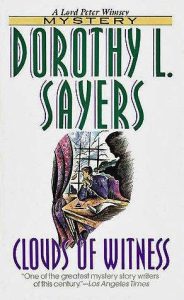
Title: Clouds of Witness
Author: Dorothy L. Sayers (1893-1957)
Date of first publication: 1926
Date first posted: March 22, 2014
Date last updated: March 13, 2025
Faded Page eBook #20081011
This eBook was produced by: Iona Vaughan, Marcia Brooks, Mark Akrigg
Paul Ereaut & the Online Distributed Proofreading Team at
http://www.pgdpcanada.net
CLOUDS OF WITNESS
THIS RE-ISSUE OF
CLOUDS OF WITNESS
(which has received _some corrections_ and _amendments_ from MISS
SAYERS) has for a Preface _a short biography of Lord Peter Wimsey_,
brought up to date (May 1935) and communicated by his uncle PAUL AUSTIN
DELAGARDIE.
WIMSEY, PETER DEATH BREDON, D.S.O.; _born_ 1890, _2nd son_
of Mortimer Gerald Bredon Wimsey, 15th Duke of Denver, and
of Honoria Lucasta, _daughter_ of Francis Delagardie of
Bellingham Manor, Hants.
_Educated:_ Eton College and Balliol College, Oxford (1st
class honours, Sch. of Mod. Hist. 1912); served with H.M.
Forces 1914/18 (Major, Rifle Brigade). _Author of:_ “Notes
on the Collecting of Incunabula,” “The Murderer’s
Vade-Mecum,” etc.
_Recreations:_ Criminology; bibliophily; music; cricket.
_Clubs:_ Marlborough; Egotists’. _Residences:_ 110A
Piccadilly, W.; Bredon Hall, Duke’s Denver, Norfolk.
_Arms:_ Sable, 3 mice courant, argent; crest, a domestic
cat couched as to spring, proper; motto: As my Whimsy takes
me.
* * * * *
BIOGRAPHICAL NOTE
_Communicated by_- PAUL AUSTIN DELAGARDIE
I am asked by Miss Sayers to fill up certain lacunæ and correct a few
trifling errors of fact in her account of my nephew Peter’s career. I
shall do so with pleasure. To appear publicly in print is every man’s
ambition, and by acting as a kind of running footman to my nephew’s
triumph I shall only be showing a modesty suitable to my advanced age.
The Wimsey family is an ancient one–too ancient, if you ask me. The
only sensible thing Peter’s father ever did was to ally his exhausted
stock with the vigorous French-English strain of the Delagardies. Even
so, my nephew Gerald (the present Duke of Denver) is nothing but a
beef-witted English squire, and my niece Mary was flighty and foolish
enough till she married a policeman and settled down. Peter, I am glad
to say, takes after his mother and me. True, he is all nerves and
nose–but that is better than being all brawn and no brains like his
father and brothers, or a mere bundle of emotions, like Gerald’s boy,
Saint-George. He has at least inherited the Delagardie brains, by way of
safeguard to the unfortunate Wimsey temperament.
Peter was born in 1890. His mother was being very much worried at the
time by her husband’s behaviour (Denver was always tiresome, though the
big scandal did not break out till the Jubilee year), and her anxieties
may have affected the boy. He was a colourless shrimp of a child, very
restless and mischievous, and always much too sharp for his age. He had
nothing of Gerald’s robust physical beauty, but he developed what I can
best call a kind of bodily cleverness, more skill than strength. He had
a quick eye for a ball and beautiful hands for a horse. He had the
devil’s own pluck, too: the intelligent sort of pluck that sees the risk
before it takes it. He suffered badly from nightmares as a child. To his
father’s consternation he grew up with a passion for books and music.
His early school-days were not happy. He was a fastidious child, and I
suppose it was natural that his school-fellows should call him “Flimsy”
and treat him as a kind of comic turn. And he might, in sheer
self-protection, have accepted the position and degenerated into a mere
licensed buffoon, if some games-master at Eton had not discovered that
he was a brilliant natural cricketer. After that, of course, all his
eccentricities were accepted as wit, and Gerald underwent the salutary
shock of seeing his despised younger brother become a bigger personality
than himself. By the time he reached the Sixth Form, Peter had contrived
to become the fashion–athlete, scholar, _arbiter elegantiarum–nec
pluribus impar_. Cricket had a great deal to do with it–plenty of Eton
men will remember the “Great Flim” and his performance against
Harrow–but I take credit to myself for introducing him to a good
tailor, showing him the way about Town, and teaching him to distinguish
good wine from bad. Denver bothered little about him–he had too many
entanglements of his own and in addition was taken up with Gerald, who
by this time was making a prize fool of himself at Oxford. As a matter
of fact Peter never got on with his father, he was a ruthless young
critic of the paternal misdemeanours, and his sympathy for his mother
had a destructive effect upon his sense of humour.
Denver, needless to say, was the last person to tolerate his own
failings in his offspring. It cost him a good deal of money to extricate
Gerald from the Oxford affair, and he was willing enough to turn his
other son over to me. Indeed at the age of seventeen, Peter came to me
of his own accord. He was old for his age and exceedingly reasonable,
and I treated him as a man of the world. I established him in
trustworthy hands in Paris, instructing him to keep his affairs upon a
sound business footing and to see that they terminated with goodwill on
both sides and generosity on his. He fully justified my confidence. I
believe that no woman has ever found cause to complain of Peter’s
treatment; and two at least of them have since married royalty (rather
obscure royalties, I admit, but royalty of a sort). Here again, I insist
upon my due share of the credit; however good the material one has to
work upon it is ridiculous to leave any young man’s social education to
chance.
The Peter of this period was really charming, very frank, modest and
well-mannered, with a pretty, lively wit. In 1909 he went up with a
scholarship to read History at Balliol, and here, I must confess, he
became rather intolerable. The world was at his feet, and he began to
give himself airs. He acquired affectations, an exaggerated Oxford
manner and a monocle, and aired his opinions a good deal, both in and
out of the Union, though I will do him the justice to say that he never
attempted to patronise his mother or me. He was in his second year when
Denver broke his neck out hunting and Gerald succeeded to the title.
Gerald showed more sense of responsibility than I had expected in
dealing with the estate; his worst mistake was to marry his cousin
Helen, a scrawny, over-bred prude, all county from head to heel. She and
Peter loathed each other cordially; but he could always take refuge with
his mother at the Dower House.
And then, in his last year at Oxford, Peter fell in love with a child of
seventeen and instantly forgot everything he had ever been taught. He
treated that girl as if she was made of gossamer, and me as a hardened
old monster of depravity who had made him unfit to touch her delicate
purity. I won’t deny that they made an exquisite pair–all white and
gold–a prince and princess of moonlight, people said. Moonshine would
have been nearer the mark. What Peter was to do in twenty years’ time
with a wife who had neither brains nor character nobody but his mother
and myself ever troubled to ask, and he, of course, was completely
besotted. Happily, Barbara’s parents decided that she was too young to
marry; so Peter went in for his final Schools in the temper of a Sir
Eglamore achieving his first dragon; laid his First-Class Honours at his
lady’s feet like the dragon’s head, and settled down to a period of
virtuous probation.
Then came the War. Of course the young idiot was mad to get married
before he went. But his own honourable scruples made him mere wax in
other people’s hands. It was pointed out to him that if he came back
mutilated it would be very unfair to the girl. He hadn’t thought of
that, and rushed off in a frenzy of self-abnegation to release her from
the engagement. I had no hand in that; I was glad enough of the result,
but I couldn’t stomach the means.
He did very well in France; he made a good officer and the men liked
him. And then, if you please, he came back on leave with his captaincy
in ’16, to find the girl married–to a hardbitten rake of a Major
Somebody, whom she had nursed in the V.A.D. hospital, and whose motto
with women was catch ’em quick and treat ’em rough. It was pretty
brutal; for the girl hadn’t had the nerve to tell Peter beforehand. They
got married in a hurry when they heard he was coming home, and all he
got on landing was a letter, announcing the _fait accompli_ and
reminding him that he had set her free himself.
I will say for Peter that he came straight to me and admitted that he
had been a fool. “All right,” said I, “you’ve had your lesson. Don’t go
and make a fool of yourself in the other direction.” So he went back to
his job with (I am sure) the fixed intention of getting killed; but all
he got was his majority and his D.S.O. for some recklessly good
intelligence work behind the German front. In 1918 he was blown up and
buried in a shell-hole near Caudry, and that left him with a bad nervous
breakdown, lasting, on and off, for two years. After that, he set
himself up in a flat in Piccadilly, with the man Bunter (who had been
his sergeant and was, and is, devoted to him), and started out to put
himself together again.
I don’t mind saying that I was prepared for almost anything. He had lost
all his beautiful frankness, he shut everybody out of his confidence,
including his mother and me, adopted an impenetrable frivolity of manner
and a dilettante pose, and became, in fact, the complete comedian. He
was wealthy and could do as he chose, and it gave me a certain amount of
sardonic entertainment to watch the efforts of post-war feminine London
to capture him. “It can’t,” said one solicitous matron, “be good for
poor Peter to live like a hermit.” “Madam,” said I, “if he did, it
wouldn’t be.” No; from that point of view he gave me no anxiety. But I
could not but think it dangerous that a man of his ability should have
no job to occupy his mind, and I told him so.
In 1921 came the business of the Attenbury Emeralds. That affair has
never been written up, but it made a good deal of noise, even at that
noisiest of periods. The trial of the thief was a series of red-hot
sensations, and the biggest sensation of the bunch was when Lord Peter
Wimsey walked into the witness-box as chief witness for the prosecution.
That was notoriety with a vengeance. Actually, to an experienced
intelligence officer, I don’t suppose the investigation had offered any
great difficulties; but a “noble sleuth” was something new in thrills.
Denver was furious; personally, I didn’t mind what Peter did, provided
he did something. I thought he seemed happier for the work, and I liked
the Scotland Yard man he had picked up during the run of the case.
Charles Parker is a quiet, sensible, well-bred fellow, and has been a
good friend and brother-in-law to Peter. He has the valuable quality of
being fond of people without wanting to turn them inside out.
The only trouble about Peter’s new hobby was that it had to be more than
a hobby, if it was to be any hobby for a gentleman. You cannot get
murderers hanged for your private entertainment. Peter’s intellect
pulled him one way and his nerves another, till I began to be afraid
they would pull him to pieces. At the end of every case we had the old
nightmares and shell-shock over again. And then Denver, of all
people–Denver, the crashing great booby, in the middle of his
fulminations against Peter’s degrading and notorious police activities,
must needs get himself indicted on a murder charge and stand his trial
in the House of Lords, amid a blaze of publicity which made all Peter’s
efforts in that direction look like damp squibs.
Peter pulled his brother out of that mess, and, to my relief, was human
enough to get drunk on the strength of it. He now admits that his
“hobby” is his legitimate work for society, and has developed sufficient
interest in public affairs to undertake small diplomatic jobs from time
to time under the Foreign Office. Of late he has become a little more
ready to show his feelings, and a little less terrified of having any to
show.
His latest eccentricity has been to fall in love with that girl whom he
cleared of the charge of poisoning her lover. She refused to marry him,
as any woman of character would. Gratitude and a humiliating inferiority
complex are no foundation for matrimony; the position was false from the
start. Peter had the sense, this time, to take my advice. “My boy,” said
I, “what was wrong for you twenty years back is right now. It’s not the
innocent young things that need gentle handling–it’s the ones that have
been frightened and hurt. Begin again from the beginning–but I warn you
that you will need all the self-discipline you have ever learnt.”
Well, he has tried. I don’t think I have ever seen such patience. The
girl has brains and character and honesty; but he has got to teach her
how to take, which is far more difficult than learning to give. I think
they will find one another, if they can keep their passions from running
ahead of their wills. He does realise, I know, that in this case there
can be no consent but free consent.
Peter is forty-five now, it is really time he was settled. As you will
see, I have been one of the important formative influences in his
career, and, on the whole, I feel he does me credit. He is a true
Delagardie, with little of the Wimseys about him except (I must be fair)
that underlying sense of social responsibility which prevents the
English landed gentry from being a total loss, spiritually speaking.
Detective or no detective, he is a scholar and a gentleman; it will
amuse me to see what sort of shot he makes at being a husband and
father. I am getting an old man, and have no son of my own (that I know
of); I should be glad to see Peter happy. But as his mother says, “Peter
has always had everything except the things he really wanted,” and I
suppose he is luckier than most.
PAUL AUSTIN DELAGARDIE
* * * * *
=_BOOKS BY DOROTHY L. SAYERS_=
THE NINE TAILORS
HANGMAN’S HOLIDAY
MURDER MUST ADVERTISE
HAVE HIS CARCASE
THE FIVE RED HERRINGS
STRONG POISON
LORD PETER VIEWS THE BODY
THE UNPLEASANTNESS AT THE BELLONA CLUB
THE DOCUMENTS IN THE CASE
(In collaboration with Robert Eustace)
UNNATURAL DEATH
CLOUDS OF WITNESS
GAUDY NIGHT
BUSMAN’S HONEYMOON
IN THE TEETH OF THE EVIDENCE
CLOUDS OF WITNESS
by
DOROTHY L. SAYERS
LONDON
VICTOR GOLLANCZ LTD
14 HENRIETTA STREET, COVENT GARDEN
_First published in 1926_
_First 2/6 edition 1935_
_Third impression January 1936_
_Fourth impression July 1937_
_Fifth impression August 1938_
_Sixth impression April 1940_
_Seventh impression October 1940_
_Eighth impression June 1941_
_Ninth impression December 1947_
_Tenth impression January 1949_
_Eleventh impression January 1950_
_Twelfth impression February 1952_
_Thirteenth impression October 1954_
_Fourteenth impression May 1958_
PRINTED AND BOUND IN ENGLAND BY
HAZELL WATSON AND VINEY LTD
AYLESBURY AND SLOUGH
THE SOLUTION OF
THE RIDDLESDALE MYSTERY
WITH
A REPORT
OF THE TRIAL OF
THE DUKE OF DENVER
BEFORE THE HOUSE OF LORDS
FOR
MURDER
The inimitable stories of Tong-king never have any real
ending, and this one, being in his most elevated style, has
even less end than most of them. But the whole narrative is
permeated with the odour of joss-sticks and honourable
high-mindedness, and the two characters are both of noble
birth.
–_The Wallet of Kai-Lung_
Table of Contents
I. “Of His malice Aforethought”
II. The Green Eyed Cat
III. Mudstains and Bloodstains
IV. –And His Daughter, Much Afraid
V. The Rue St. Honoré and the Rue de la Paix
VI. mary Quite Contrary
VII. The Club and the Bullet
VIII. Mr. Parker Takes Notes
IX. Goyles
X. Nothing Abides at the Noon
XI. Meribah
XII. The Alibi
XIII. Manon
XIV. The Edge of the Axe Towards Him
XV. Bar Falling
XVI. The Second String
XVII. The Eloquent Dead
XVIII. The Speech for the Defence
XIX. Who Goes Home




Reader notes
Loading reader notes…