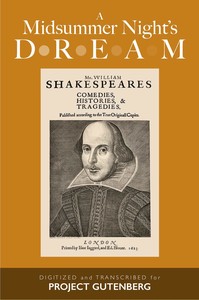
A MIDSUMMER NIGHT’S DREAM
by William Shakespeare
Contents
ACT I
Scene I.
Athens. A room in the Palace of Theseus
Scene II.
The Same. A Room in a Cottage
ACT II
Scene I.
A wood near Athens
Scene II.
Another part of the wood
ACT III
Scene I.
The Wood.
Scene II.
Another part of the wood
ACT IV
Scene I.
The Wood
Scene II.
Athens. A Room in Quince’s House
ACT V
Scene I.
Athens. An Apartment in the Palace of Theseus
Dramatis Personæ
THESEUS, Duke of Athens
HIPPOLYTA, Queen of the Amazons, bethrothed to Theseus
EGEUS, Father to Hermia
HERMIA, daughter to Egeus, in love with Lysander
HELENA, in love with Demetrius
LYSANDER, in love with Hermia
DEMETRIUS, in love with Hermia
PHILOSTRATE, Master of the Revels to Theseus
QUINCE, the Carpenter
SNUG, the Joiner
BOTTOM, the Weaver
FLUTE, the Bellows-mender
SNOUT, the Tinker
STARVELING, the Tailor
OBERON, King of the Fairies
TITANIA, Queen of the Fairies
PUCK, or ROBIN GOODFELLOW, a Fairy
PEASEBLOSSOM, Fairy
COBWEB, Fairy
MOTH, Fairy
MUSTARDSEED, Fairy
PYRAMUS, THISBE, WALL, MOONSHINE, LION; Characters in the Interlude
performed by the Clowns
Other Fairies attending their King and Queen
Attendants on Theseus and Hippolyta
SCENE: Athens, and a wood not far from it
ACT I
SCENE I. Athens. A room in the Palace of Theseus
Enter Theseus, Hippolyta, Philostrate and Attendants.
THESEUS.
Now, fair Hippolyta, our nuptial hour
Draws on apace; four happy days bring in
Another moon; but oh, methinks, how slow
This old moon wanes! She lingers my desires,
Like to a step-dame or a dowager,
Long withering out a young man’s revenue.
HIPPOLYTA.
Four days will quickly steep themselves in night;
Four nights will quickly dream away the time;
And then the moon, like to a silver bow
New bent in heaven, shall behold the night
Of our solemnities.
THESEUS.
Go, Philostrate,
Stir up the Athenian youth to merriments;
Awake the pert and nimble spirit of mirth;
Turn melancholy forth to funerals;
The pale companion is not for our pomp.
[_Exit Philostrate._]
Hippolyta, I woo’d thee with my sword,
And won thy love doing thee injuries;
But I will wed thee in another key,
With pomp, with triumph, and with revelling.
Enter Egeus, Hermia, Lysander and Demetrius.
EGEUS.
Happy be Theseus, our renownèd Duke!
THESEUS.
Thanks, good Egeus. What’s the news with thee?
EGEUS.
Full of vexation come I, with complaint
Against my child, my daughter Hermia.
Stand forth, Demetrius. My noble lord,
This man hath my consent to marry her.
Stand forth, Lysander. And, my gracious Duke,
This man hath bewitch’d the bosom of my child.
Thou, thou, Lysander, thou hast given her rhymes,
And interchang’d love-tokens with my child.
Thou hast by moonlight at her window sung,
With feigning voice, verses of feigning love;
And stol’n the impression of her fantasy
With bracelets of thy hair, rings, gauds, conceits,
Knacks, trifles, nosegays, sweetmeats (messengers
Of strong prevailment in unharden’d youth)
With cunning hast thou filch’d my daughter’s heart,
Turn’d her obedience (which is due to me)
To stubborn harshness. And, my gracious Duke,
Be it so she will not here before your grace
Consent to marry with Demetrius,
I beg the ancient privilege of Athens:
As she is mine I may dispose of her;
Which shall be either to this gentleman
Or to her death, according to our law
Immediately provided in that case.
THESEUS.
What say you, Hermia? Be advis’d, fair maid.
To you your father should be as a god;
One that compos’d your beauties, yea, and one
To whom you are but as a form in wax
By him imprinted, and within his power
To leave the figure, or disfigure it.
Demetrius is a worthy gentleman.
HERMIA.
So is Lysander.
THESEUS.
In himself he is.
But in this kind, wanting your father’s voice,
The other must be held the worthier.
HERMIA.
I would my father look’d but with my eyes.
THESEUS.
Rather your eyes must with his judgment look.
HERMIA.
I do entreat your Grace to pardon me.
I know not by what power I am made bold,
Nor how it may concern my modesty
In such a presence here to plead my thoughts:
But I beseech your Grace that I may know
The worst that may befall me in this case,
If I refuse to wed Demetrius.
THESEUS.
Either to die the death, or to abjure
For ever the society of men.
Therefore, fair Hermia, question your desires,
Know of your youth, examine well your blood,
Whether, if you yield not to your father’s choice,
You can endure the livery of a nun,
For aye to be in shady cloister mew’d,
To live a barren sister all your life,
Chanting faint hymns to the cold fruitless moon.
Thrice-blessèd they that master so their blood
To undergo such maiden pilgrimage,
But earthlier happy is the rose distill’d
Than that which, withering on the virgin thorn,
Grows, lives, and dies, in single blessedness.
HERMIA.
So will I grow, so live, so die, my lord,
Ere I will yield my virgin patent up
Unto his lordship, whose unwishèd yoke
My soul consents not to give sovereignty.
THESEUS.
Take time to pause; and by the next new moon
The sealing-day betwixt my love and me
For everlasting bond of fellowship,
Upon that day either prepare to die
For disobedience to your father’s will,
Or else to wed Demetrius, as he would,
Or on Diana’s altar to protest
For aye austerity and single life.
DEMETRIUS.
Relent, sweet Hermia; and, Lysander, yield
Thy crazèd title to my certain right.
LYSANDER.
You have her father’s love, Demetrius.
Let me have Hermia’s. Do you marry him.
EGEUS.
Scornful Lysander, true, he hath my love;
And what is mine my love shall render him;
And she is mine, and all my right of her
I do estate unto Demetrius.


Comments
Loading comments…